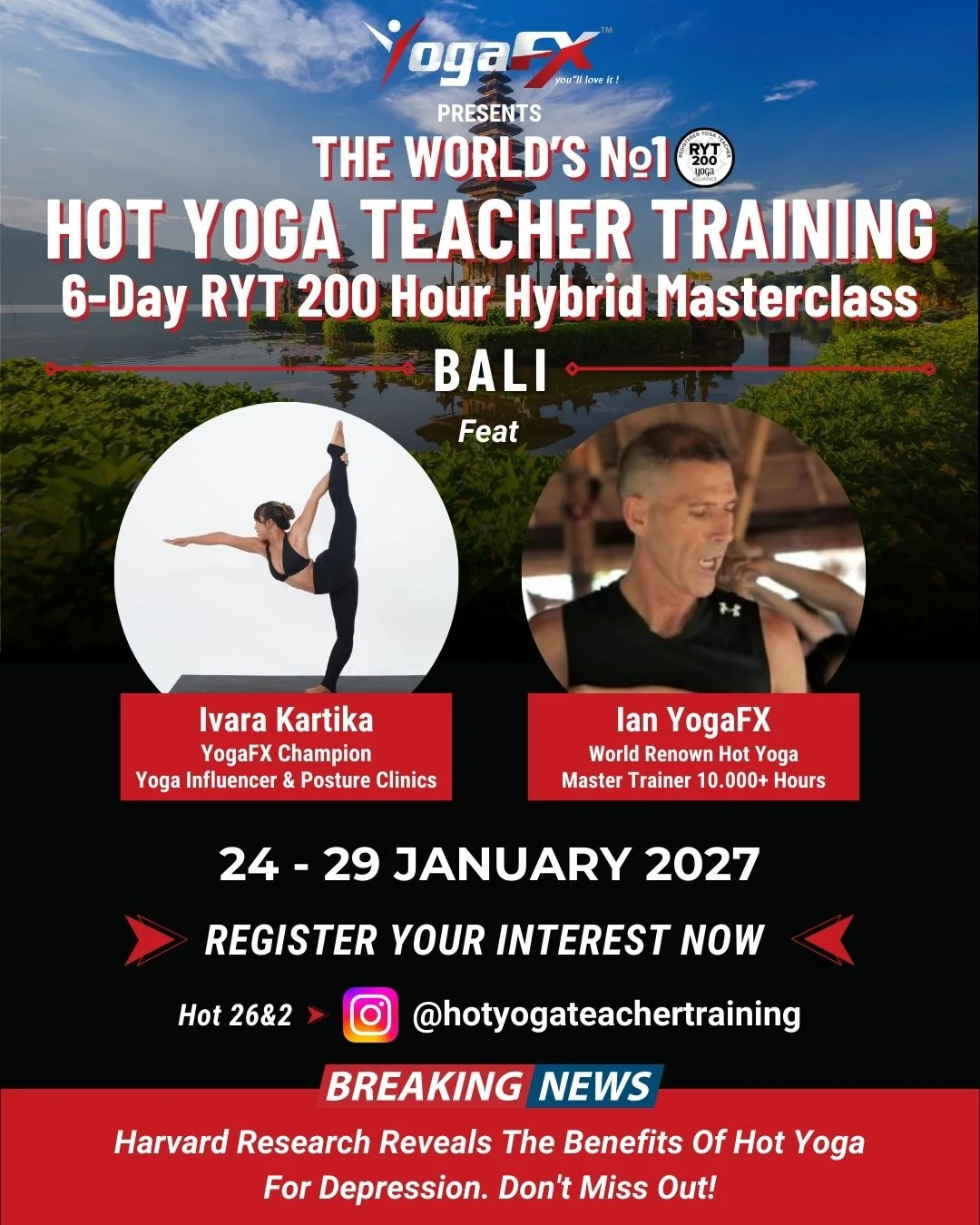
Hot Yoga Teacher Training: The Complete Guide to Choosing the Right Program
By Ian Terry, E-RYT 500, Master Trainer of the Republic of Indonesia Yogasana Sports Federation · Updated

Hot yoga teacher training is professional preparation for teaching yoga safely, clearly, and consistently in a heated room. The right program combines method-specific practice, anatomy, communication, supervised teaching, assessment, and a credential whose meaning is explained before you pay. It should also help you decide whether teaching is truly the path you want. A polished sales page cannot answer that question for you, but the program's structure, trainer access, graduate outcomes, and willingness to discuss limitations can. This guide explains how to compare a 200 hour yoga teacher training, a method-specific course, and a complete 200 hour yoga teacher training program without relying on vague promises.
What Is Hot Yoga Teacher Training?
A hot yoga teacher training course combines general teaching foundations with the additional skills required for cueing, observing, and protecting students in a heated room. When people compare yoga teacher training for hot yoga, they should confirm the method, temperature, practical hours, and assessment rather than relying on the course name alone.
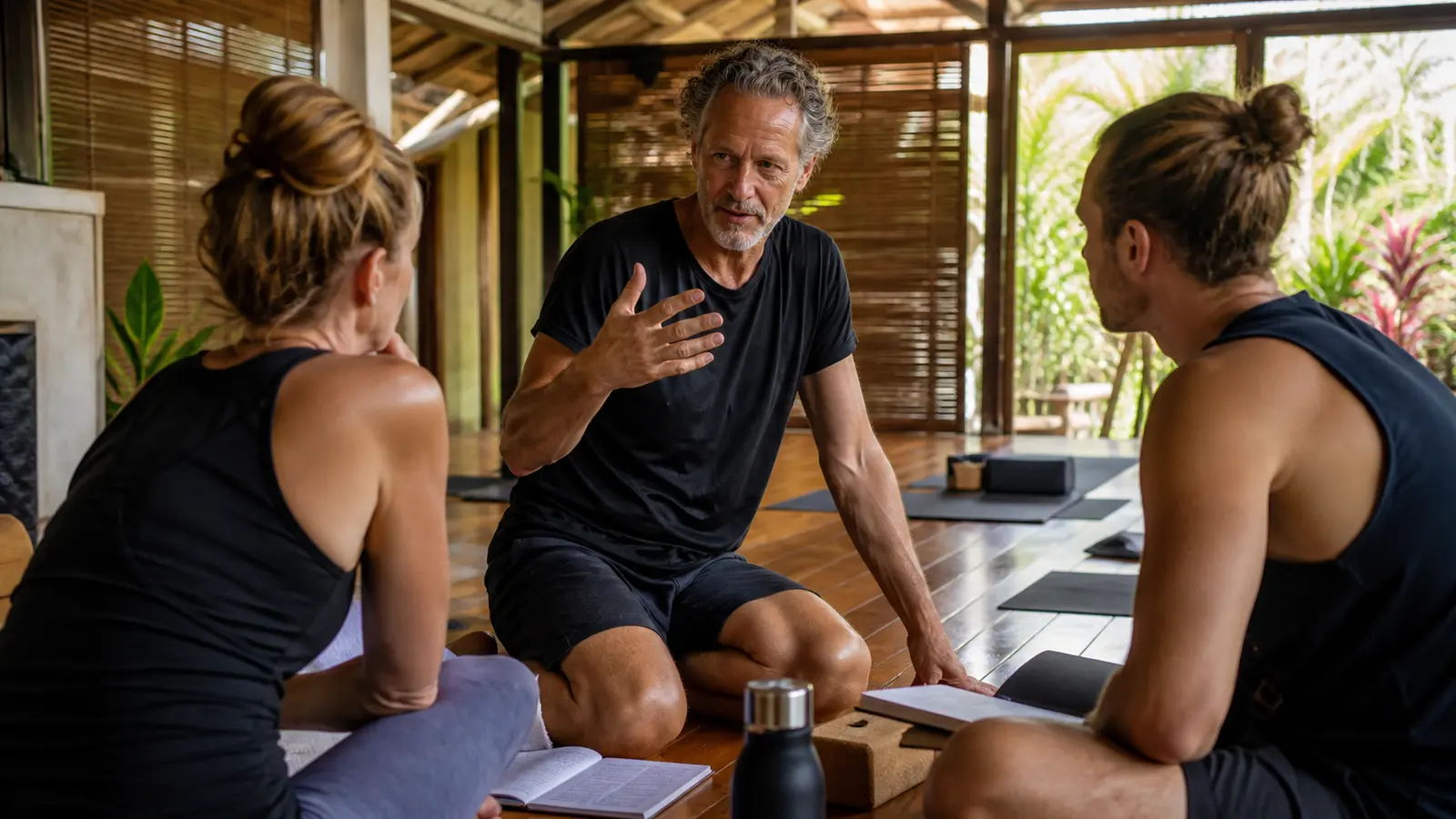
Hot yoga teacher training teaches you how to turn personal practice into a class that other people can follow. That shift is larger than many students expect. As a practitioner, you mainly manage your own breath, alignment, attention, and response to heat. As a teacher, you must observe a room, choose useful words, maintain timing, notice risk, create a workable pace, and keep your own reactions from distracting the students. A course should make that responsibility concrete from the beginning.
The phrase "hot yoga" does not identify one universal method. Some schools teach a fixed sequence. Others teach creative flows, strength-focused formats, or a mixture of styles inside a heated room. Temperatures, class lengths, music policies, cueing systems, and teacher responsibilities can differ. Before comparing prices, identify what you are being trained to teach. A broad credential may support general yoga teaching, while a method-specific certificate can document additional study in a particular sequence. When a school markets the best hot yoga teacher training, ask it to define the method, assessment, and graduate outcome behind that claim.
Original Hot 26&2 Yoga uses 26 postures and two breathing exercises in a fixed 90-minute class. The method asks the teacher to deliver scripted verbal dialogue without demonstrating and without music. That format places unusual weight on language, observation, memory, timing, and room leadership. You cannot disappear into your own practice at the front of the room. You must watch the students and teach the people who are actually there.
Good training also distinguishes intensity from recklessness. Heat can make a class feel dramatic, but drama is not proof of quality. Teachers need practical education about hydration, acclimatisation, pacing, consent, modifications, and the signs that someone needs to stop. Students should never be pressured to ignore concerning symptoms for the sake of discipline. The teacher's job is to build a focused environment while respecting individual limits.
You do not have to arrive with a perfect practice. In fact, physical performance alone is a poor predictor of teaching ability. Curiosity, reliability, patience, voice, listening, and the capacity to apply feedback often matter more. A credible admissions conversation should explore your practice history, motivation, health considerations, schedule, and expectations instead of promising that every applicant will leave ready for every class.
Methods and Teaching Skills You May Study
Start by examining the curriculum as a teaching system rather than a list of impressive nouns. "Anatomy, philosophy, sequencing, and practicum" sounds complete, but it tells you little about depth. Ask how those subjects are taught, who teaches them, how understanding is assessed, and how often you will apply them. A useful anatomy session should influence the cues you give. A philosophy discussion should shape how you treat students, not sit separately from the practical course.
Dialogue, cueing, and voice
In a dialogue-led method, words are your primary teaching tool. Trainees need time to learn the sequence, understand the purpose of each instruction, practise pronunciation, control pace, and adapt volume without shouting for 90 minutes. Memorisation can create a stable foundation, but effective delivery is not robotic. You still need to see when a room is confused, when an instruction lands, and when silence gives students space to work.
Observation and classroom management
Teaching a heated room requires wider attention. Where are the first-time students? Is somebody becoming unsteady? Are experienced practitioners rushing because they know the sequence? Is the room organised so that people can move safely? Training should give you repeated opportunities to scan, prioritise, and respond. These skills grow through live practice and direct feedback, not through watching lectures alone.
Anatomy, safety, and scope
Teachers need functional knowledge of movement, common limitations, and the difference between instruction and medical advice. You are not diagnosing injuries. You are learning to give clear general guidance, offer appropriate options within your training, and refer students to qualified professionals when necessary. A program should be explicit about teacher scope and should never teach health promises as marketing language.
Practice teaching and assessment
Ask how many times you will teach before final assessment. One polished presentation is not enough. Productive practice includes short segments, full postures, transitions, difficult room scenarios, peer classes, and formal assessment. The feedback should be specific enough to use immediately. "More confidence" is vague. "Slow the setup, look at the back row, and finish the breathing instruction before correcting alignment" gives you a task for the next round.
What the Research Can and Cannot Tell You
Research can help you discuss heated yoga responsibly, but it cannot justify a promise that every student will receive the same result. A 2025 systematic review by Willmott and colleagues examined reported outcomes associated with Bikram yoga, including areas such as flexibility and bone-related measures. The review is useful context, yet differences in study design, populations, frequency, and controls mean that teachers should speak with care rather than turning research headlines into guarantees. You can read the systematic review in PubMed Central.
A 2023 randomised controlled trial led by Maren Nyer studied community-delivered heated hatha yoga for adults with moderate-to-severe depression. Participants assigned to heated yoga showed a greater reduction in clinician-rated symptoms than a waitlist group, and the researchers described the findings as preliminary evidence that warranted further study with active controls. That language matters. The study does not make a yoga teacher a mental health clinician, and it does not support telling a student to replace treatment. Read the Nyer et al. trial on PubMed.
Earlier research has explored strength, flexibility, body composition, cardiovascular demand, and energy expenditure in Bikram-style practice. Those studies can guide better questions, but small samples and specific protocols limit broad conclusions. The honest teacher says "research suggests" or "may help" and remains clear that a class is not a prescription. Claims about sweating removing toxins are not supported by the teaching method and should not be part of responsible course marketing.
Heat also changes the practical risk discussion. People differ in acclimatisation, medication use, pregnancy status, cardiovascular history, hydration, sleep, and tolerance. If you have a medical condition, are pregnant, take medication that affects heat response, or are unsure whether heated exercise suits you, consult a healthcare professional before training. During class, dizziness, confusion, chest pain, faintness, or unusual distress should never be reframed as personal weakness.
The research section of a teacher training should therefore teach literacy as much as findings. Who participated? What was the intervention? Was there an active comparison? How long did the study last? What did researchers actually measure? When trainees learn to ask these questions, they become less vulnerable to exaggerated wellness claims and more capable of communicating with students in plain, accurate language.
How to Choose the Right Program
Choosing well is a process of evidence gathering. Do not begin with the question, "Which course looks most exciting?" Begin with, "What will I be able to do, what must I complete, and who will evaluate me?" Then collect written answers. A serious provider will welcome detailed questions because informed trainees arrive with more realistic expectations.
- Define your outcome. Decide whether you want to teach professionally, deepen a personal practice, add a method to existing credentials, or test a career change.
- Identify the method. Confirm the sequence, temperature, class length, cueing style, use of music, and whether demonstrations are expected.
- Verify trainer experience. Ask who teaches most hours, who assesses practicum, and whether the lead trainer is accessible during the course.
- Inspect practicum design. Request the number and type of live teaching opportunities, feedback rounds, and final assessment requirements.
- Read credential language. Understand the difference between course completion, school-issued certification, and registration with an external organisation.
- Calculate the full cost. Include travel, accommodation, food, materials, insurance, missed work, certification fees, and possible resits.
- Speak to graduates. Ask what surprised them, where they felt underprepared, and what support remained available afterward.
Cohort size affects access. A large room can create energy, but individual dialogue correction and live teaching feedback take time. Ask how many trainees share each trainer and how practicum is scheduled. A stated maximum is more useful than a vague promise of personal attention. Also ask what happens if enrolment is low, a trainer changes, or you need to defer.
Format matters differently for different lives. A career changer with full-time work may need online preparation. A serious practitioner may want a concentrated in-person environment away from routine. Neither preference determines quality by itself. The key is matching each subject to the medium that can teach it. Reading and lectures travel well online. Heat adaptation, observation, room voice, and supervised teaching deserve direct practice.
Look for operational detail too. Who answers questions before arrival? What does a normal day look like? How are injuries or missed sessions handled? Is the studio open for additional practice? Are accommodation and transport separate? Specific answers show that the school has run the process before. Evasive answers transfer preventable uncertainty to you.
Cost, Format, and Certification
Tuition is only one line in the real cost of training. Build a simple comparison sheet and use the same categories for every program. If one school includes course materials and assessment while another charges separately, headline prices are not comparable. If an intensive requires international travel, calculate the trip honestly. A cheaper course that does not deliver enough supervised teaching may cost more later when you seek further mentoring.
| Category | Questions to ask | Why it matters |
|---|---|---|
| Tuition | Is this the full program price? Are taxes included? | Prevents surprise balances before certification. |
| Practicum | How much live teaching and feedback is included? | Shows whether skill development is central. |
| Credential | What is awarded and what must I complete? | Clarifies professional outcome and conditions. |
| Travel | Are flights, transfers, and visas separate? | Reveals the realistic trip budget. |
| Living costs | Are accommodation and meals included? | Makes residential formats comparable. |
| Aftercare | Is mentoring available after graduation? | Supports the move from trainee to teacher. |
Certification language deserves the same discipline. A Yoga Alliance RYT 200 pathway and a method-specific certificate answer different questions. One relates to completion of a registered 200-hour education pathway and subsequent registration choices. The other records training in a specific practice system. Ask whether both are included, who issues each document, what assessment is required, and whether there are continuing obligations. If you are searching for a 200 hour yoga teacher training Yoga Alliance pathway, verify the school's current registration and read what that registration does and does not mean.
Online, in-person, and hybrid formats each involve trade-offs. Fully online education can reduce travel and improve schedule flexibility. In-person intensives create immediate feedback, shared practice, and clearer observation of teaching under heat. Hybrid design can put foundational study before arrival, preserving valuable studio time for dialogue, practice, correction, and assessment. The label "hybrid" is not enough. Ask exactly which hours happen where.
If you are comparing delivery models, the planned guide on whether online hot yoga teacher training is worth it will help you judge what belongs online. For curriculum detail, see what a 200-hour yoga teacher training should actually teach. Cost deserves its own worksheet, covered in the full hot yoga teacher training cost breakdown.
The YogaFX Approach in Bali
YogaFX has delivered its teacher training pathway since 2017. The program combines an online pre-course with a six-day intensive in Bali, limits each cohort to 19 participants, and lists a flat tuition of USD 1,699. Graduates who successfully complete the requirements receive Yoga Alliance RYT 200 and Bikram Hot 26&2 certification. Those details are published so a prospective trainee can compare the offer on concrete terms rather than mood alone.
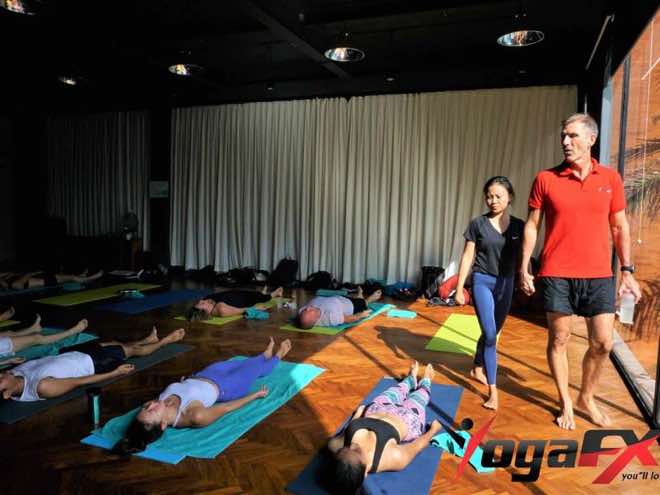
The practical method is Original Hot 26&2 Yoga: 26 postures, two breathing exercises, a fixed 90-minute class, scripted verbal dialogue, no demonstration, and no music. Training uses Bali's natural tropical heat, not electric heaters, at approximately 40°C and 40% humidity. Studio activity spans Seminyak and Canggu, with locations operating from 06:00 to 22:00 daily. The environment is beautiful, but the intensive is structured work. This is the academy's original hot yoga teacher training pathway, with method-specific dialogue practice layered onto the broader 200-hour foundation.
Mr. Ian Terry brings more than 12,000 teaching hours to the room. He completed five direct training sessions under Bikram Choudhury between 2012 and 2019 and was confirmed in June 2026 as Master Trainer of the Republic of Indonesia Yogasana Sports Federation. More than 1,500 graduates from over 80 countries have trained through the academy. His role is not reduced to appearing at an opening talk. The value lies in hearing correction from someone who understands how dialogue, timing, and observation interact across a full class.
Social proof can help you form questions, but it should not replace them. The academy reports 700+ reviews across Google, Yoga Alliance, and YouTube. Read and watch for specifics: Did graduates practise teaching? Did feedback change their delivery? Could they explain what the credential required? A large review count is most useful when you examine the experiences behind it.
Named alumni outcomes add another layer of evidence. YogaFX graduates Ivara Candra Kartika and Arkan Fauzan Riyanto have represented Indonesia in Yogasana competition. Their reported results include medals at FORNAS Indonesia, the Asian Yogasana Championships, and the 2026 World Yogasana Sports Federation Championships in Ahmedabad. Graduate Slamet Ariyanto has moved into national leadership as Chairman of PPYNI and an Indonesian Yogasana team manager. These are exceptional individual pathways, not guaranteed outcomes, but they show how teacher education can support teaching, athletic competition, and organizational leadership.
The hybrid sequence is designed for people who cannot disappear from work for months but still need live teaching experience. You prepare terminology, sequence, theory, and dialogue before Bali. The intensive then concentrates on heat, room presence, practical correction, repetition, and assessment. It is demanding by design. The maximum cohort of 19 protects the possibility of direct feedback while keeping enough classmates for real room practice.
If this balance fits your goal, review the full YogaFX teacher training program and speak with Mr. Ian Terry on WhatsApp before enrolling. Ask the difficult questions listed in this guide. A serious decision deserves a direct conversation about your practice, schedule, expectations, and readiness.
Watch the YogaFX Training Environment in Bali
The World's No.1 Bikram Hot 26&2 Yoga Teacher Training RYT 200H In Beautiful Bali - YogaFX
See an earlier YogaFX Bikram Hot 26&2 teacher training cohort in Bali and compare the visible practical environment with the program-selection criteria in this guide.
Do you have what it takes to become a great Bikram Hot Yoga teacher? Complete the short YogaFX readiness quiz to understand where you are on your teaching path and receive more personalized guidance.
Video context: the recording advertises an earlier seven-day format and January intake. The current pathway combines online preparation with a six-day practical MasterClass. Confirm current dates and inclusions before enrolling.
Your Next Steps Before You Enrol
Give yourself a week to compare programs properly. Create a shortlist, request written curriculum and pricing, attend a class in the relevant method if possible, and schedule a call with the person who will actually train you. Notice whether the conversation makes the work clearer or simply increases pressure to pay. A good admissions process should leave you better informed even if you decide not to enrol.
Then assess your current life. Can you protect the study time? Can you practise enough to arrive physically prepared? Does your budget include travel and time away from work? Are you willing to receive correction publicly and repeat material until it becomes reliable? Teacher training can be transformational, but transformation is usually built from ordinary disciplines: preparation, humility, repetition, rest, and honest feedback.
Start with the guide explaining what hot yoga is, then compare heat yoga temperatures and class types, use the first-class preparation guide, and review the heat yoga training selection checklist. Next, read what Bikram yoga teacher training means today and compare Bikram and Vinyasa as teaching careers. Continue your research with finding credible hot yoga teacher training near you, weighing the pros, cons, and red flags, changes shaping hot yoga teacher training in 2027, and the difference between Bikram and broader hot yoga training. If Bali is on your shortlist, use the 200-hour yoga teacher training in Bali booking guide to compare location-specific details. Those questions are easier once you understand the foundation explained here.
For the career decision, follow the full path on how to become a certified yoga instructor, then compare the evidence-based yoga teacher salary breakdown before building an income forecast.
Frequently Asked Questions
Do I need years of hot yoga experience before teacher training?
You do not need to perform every posture at an advanced level, but you should have a steady practice and understand how your body responds to heat. A responsible school will assess readiness, explain its prerequisites, and value coachability, observation, communication, and consistent effort alongside physical ability.
Does a 200-hour credential automatically make someone a good teacher?
No. A credential confirms that stated requirements were completed, not that every graduate teaches equally well. Look for supervised teaching, specific feedback, anatomy education, clear assessment standards, and continued mentorship. Your real development begins when you apply those foundations consistently with students after graduation.
Can hot yoga teacher training be completed entirely online?
Theory, anatomy, philosophy, and dialogue preparation can work well online. Heat adaptation, room observation, voice control, and live teaching assessment are harder to evaluate through a screen. A hybrid format can preserve flexible preparation while requiring practical work with trainers and real classmates in person.
What should the total training price include?
Ask for a written list covering tuition, course materials, assessments, certification fees, practice access, accommodation, meals, transport, and resits. Compare the final expected spend rather than the advertised deposit. A transparent provider should also explain refund terms and any expenses paid separately to third parties.
Is this official Bikram Choudhury Teacher Training?
Independent training, not official Bikram Choudhury Teacher Training. The program teaches Original Hot 26&2 Yoga and awards its stated Yoga Alliance RYT 200 and Bikram Hot 26&2 certifications after successful completion. Ask the team directly if you need written clarification about credential scope or recognition.