26 Bikram Hot Yoga Postures: Poses, Positions and Series
By Ian Terry, E-RYT 500 · Updated
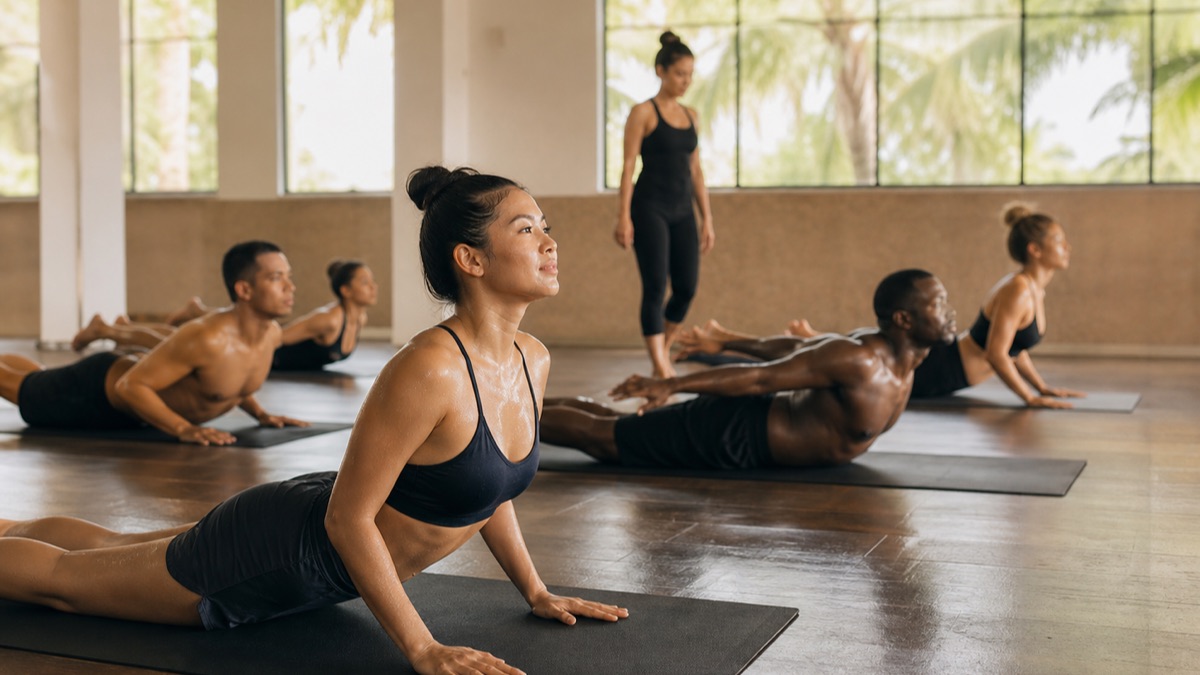
The 26 Bikram hot yoga postures form a fixed 26+2 sequence practised for 90 minutes in a room heated to approximately 105°F (40°C) with about 40% humidity. This complete Bikram hot yoga poses chart names every one of the Bikram yoga positions in English and Sanskrit as the class moves from breathing into the standing series, floor series, and closing breathwork.
Want every posture in order, filtered by difficulty, focus area or health benefit?
How the Bikram 26+2 Sequence Is Counted
New to the format? Start with what 26 and 2 yoga means, then return here for the complete posture-by-posture reference.
Bikram Hot Yoga is commonly described as 26 postures and two breathing exercises. Published research describes a 90-minute standardized sequence bookended by Standing Deep Breathing and Blowing in Firm. Studio lists may still display 26 numbered teaching entries because two posture pairs are grouped and Sit-Up is shown as a repeated transition.
In the reference below, Half Moon and Hands-to-Feet share entry 2, while Head-to-Knee and Stretching share entry 24. Sit-Up appears at entry 15 because students encounter it repeatedly in the floor series. Pranayama and Kapalbhati are breathing exercises rather than asanas, although everyday studio language often calls the complete list “the 26 poses.”
This explains why reputable diagrams can show slightly different numbers without changing the practical class. The order matters more than whether a source counts a grouped phase, a transition, or a breathing exercise as an individual posture.
For photographs, filters, difficulty levels, posture areas, timers, and printable details, open the interactive Bikram Yoga 26 poses guide. Use this article as a concise Bikram hot yoga positions reference and the interactive page as a visual poses chart.
Standing and Balancing Bikram Hot Yoga Poses
The class begins with Standing Deep Breathing, then moves through side bends, a forward fold, three stages of Awkward Pose, Eagle, and progressively demanding single-leg balances. The wide-leg section follows before Tree and Toe Stand close the standing work.
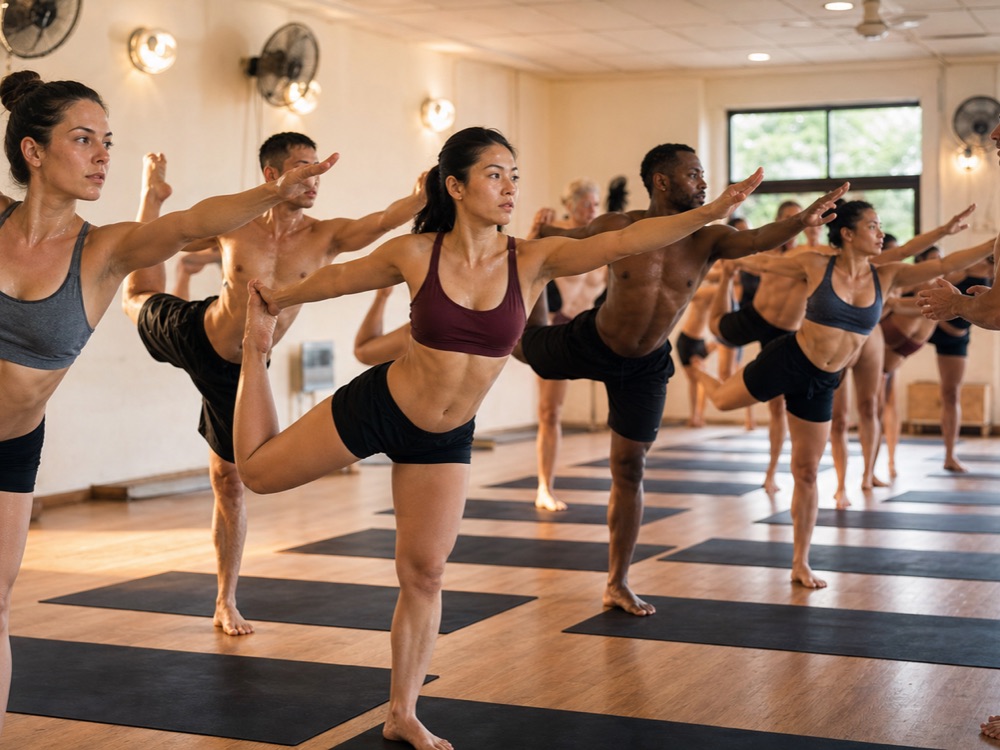
The standing series raises body temperature and asks for sustained leg and trunk work. Its balance poses also provide immediate feedback: gaze, breath, foot pressure, and attention influence stability. A student does not need the final expression to participate. Stable foundations are part of the sequence, not a lesser version of it.
A randomized controlled trial indexed in PubMed reported improvements in deadlift strength, lower-back and hamstring flexibility, shoulder flexibility, and balance after eight weeks of Bikram training in the studied group. These group findings do not establish a medical benefit for each individual pose.
Floor Series of Bikram Hot Yoga Poses
Savasana creates the transition to floor work. Wind-Removing Pose follows, then repeated Sit-Ups connect rest periods with the back-strengthening series: Cobra, Locust, Full Locust, and Bow. Fixed Firm, Half Tortoise, Camel, Rabbit, seated stretching, and Spine-Twisting complete the asana work before final breathing.
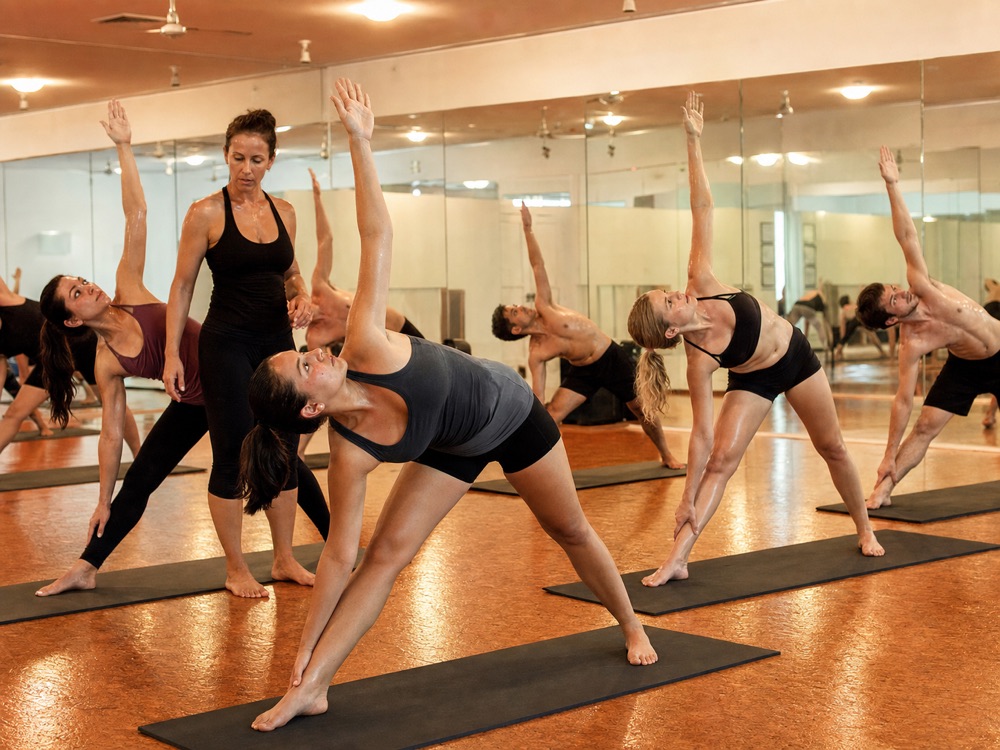
The floor sequence does not justify forcing vulnerable joints. Fixed Firm requires particular care around knees and ankles. Camel and Bow should develop through active control rather than momentum. Rabbit should not transfer aggressive load into the head or neck. Individual injury or surgery history belongs in a conversation with a qualified healthcare professional.
Bikram Yoga Positions: Chart of All 26 Hot Yoga Postures
This ordered chart follows the Bikram hot yoga series from its opening breathing exercise through the standing and floor positions to final breathwork. Each entry gives the commonly used English pose name, its Sanskrit name, and the main physical task without presenting the list as medical advice.
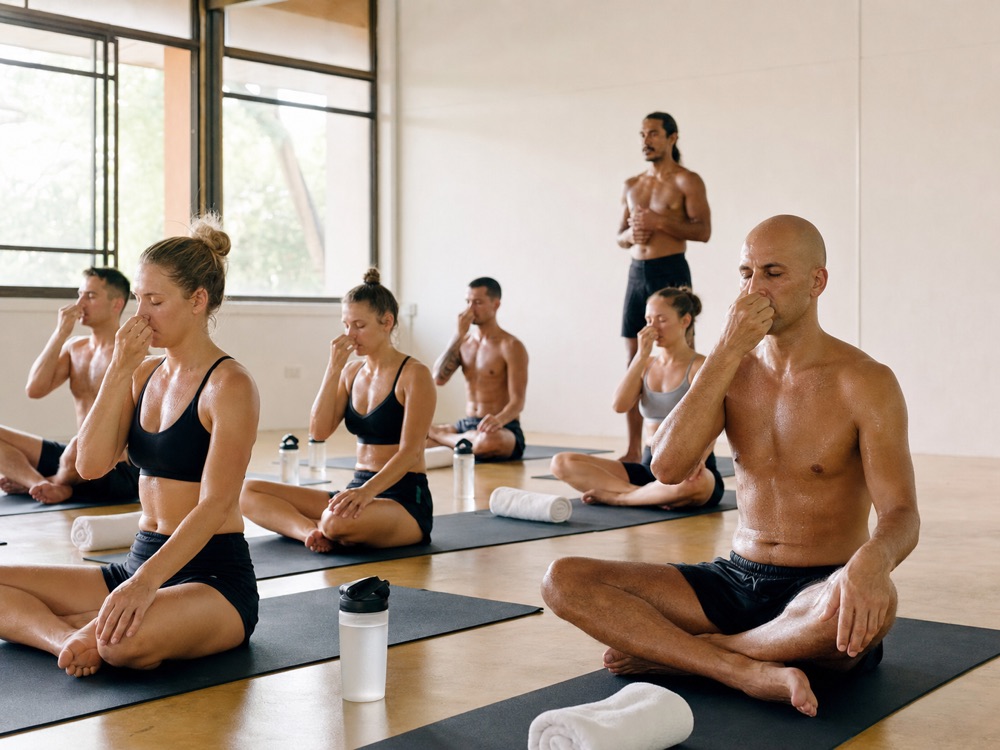
Standing Deep Breathing (Pranayama) – The opening breathing exercise establishes pace, posture, and attention before the standing series.
Half Moon Pose with Hands-to-Feet Pose (Ardha Chandrasana with Pada Hastasana) – Side bending, backbending, and a forward fold mobilize the spine and load the trunk and legs through controlled ranges.
Awkward Pose (Utkatasana) – Three squat-like stages challenge the thighs, hips, ankles, and balance.
Eagle Pose (Garudasana) – A wrapped standing balance coordinates the ankles, knees, hips, shoulders, arms, and focused gaze.
Standing Head-to-Knee Pose (Dandayamana Janushirasana) – A demanding single-leg balance develops concentration and progressive leg and trunk control.
Standing Bow-Pulling Pose (Dandayamana Dhanurasana) – The standing backbend combines balance, shoulder mobility, leg drive, and focused attention.
Balancing Stick Pose (Tuladandasana) – A brief horizontal balance challenges whole-body tension, alignment, and cardiovascular response.
Standing Separate-Leg Stretching Pose (Dandayamana Bibhaktapada Paschimottanasana) – The wide forward fold emphasizes the hamstrings, hips, and back body without requiring forced depth.
Triangle Pose (Trikonasana) – The bent-knee stance combines leg endurance, hip opening, lateral reach, and trunk control.
Standing Separate-Leg Head-to-Knee Pose (Dandayamana Bibhaktapada Janushirasana) – This asymmetrical forward fold asks for square hips, abdominal engagement, concentration, and gradual mobility.
Tree Pose (Tadasana) – A quieter standing balance develops hip control, posture, and steady gaze after the stronger standing work.
Toe Stand Pose (Padangustasana) – The closing standing balance places high demands on foot, ankle, knee, hip, and concentration; beginners can remain in Tree.
Dead Body Pose (Savasana) – The supine pause separates standing from floor work and lets breathing and heart rate begin to settle.
Wind-Removing Pose (Pavanamuktasana) – Drawing one or both knees toward the trunk creates a controlled hip and abdominal compression while the back remains supported.
Active Transition (Sit-Up) – This repeated transition links Savasana to later floor postures; it is often listed for teaching reference even when not counted as a separate asana.
Cobra Pose (Bhujangasana) – The first back-strengthening posture uses spinal extensor work while the legs and pelvis remain grounded.
Locust Pose (Salabhasana) – Locust shifts emphasis across the posterior chain and challenges arm placement, back strength, and leg lift.
Full Locust Pose (Poorna Salabhasana) – The wider full-body lift develops mid-back strength and controlled extension without chasing maximum height.
Bow Pose (Dhanurasana) – Holding the feet while kicking back creates a full-spine backbend and opens the front body.
Fixed Firm Pose (Supta Vajrasana) – The kneeling progression targets the front thighs, ankles, and knees; range must match individual joint tolerance.
Half Tortoise Pose (Ardha Kurmasana) – A kneeling forward reach provides a quieter shoulder, trunk, and breathing transition.
Camel Pose (Ustrasana) – The deepest kneeling backbend in the sequence emphasizes hip extension, chest opening, and progressive spinal control.
Rabbit Pose (Sasangasana) – The rounded forward shape counterbalances Camel and trains controlled spinal flexion without loading the head or neck aggressively.
Head-to-Knee Pose with Stretching Pose (Janushirasana with Paschimottanasana) – The paired seated folds emphasize hamstring, calf, and back-body mobility while maintaining deliberate alignment.
Spine-Twisting Pose (Ardha Matsyendrasana) – The closing seated twist distributes rotation through the trunk rather than forcing one spinal segment.
Blowing in Firm Pose (Kapalbhati in Vajrasana) – The final active breathing exercise uses short forceful exhalations to move air out before the class returns to rest.
How to use this Bikram hot yoga poses chart
Read the chart from top to bottom because Bikram yoga positions are not selected at random or rearranged by focus area. The standing series comes first, Savasana marks the move to the floor, and short recovery periods separate later postures. Memorizing the position names can make class cues easier to follow, but safe alignment still depends on live instruction and individual range.
Names and transliterations vary. For example, Hands-to-Feet appears as Pada Hastasana or Pada-Hasthasana, and Triangle may appear as Trikonasana or Trikanasana in studio material. Use the teacher's terminology while recognizing the same place and action in the fixed sequence.
Why the Bikram Hot Yoga Pose Order Stays Fixed
A fixed sequence reduces uncertainty. Students know what comes next and can compare how the same posture feels across days. Teachers share a stable timing and dialogue framework. That consistency can support focused study, but it does not mean every body should produce one identical shape.
Each section also changes the task gradually. The standing series builds heat and balance. Savasana introduces recovery. The prone back-strengthening group precedes deeper kneeling backbends. Rabbit counterbalances Camel, while seated folds and a twist lead toward closing breathing.
The sequence is fixed, but effort is not. Sleep, hydration, health, experience, room conditions, and stress can change the appropriate dose on any day. Measurable practice means noticing those variables, not overriding them.
Read the evidence-focused guide to Bikram hot yoga benefits for what research supports and where traditional posture claims exceed current evidence. For a position-by-position comparison, see the Bikram yoga 26 poses benefits guide.
How Beginners Should Practise the Bikram Hot 26+2 Sequence
Preview the order, but learn the poses in a supervised class rather than treating a list as complete instruction. Arrive hydrated, tell the teacher you are new, and use an honest starting position. Stop for sharp pain, confusion, dizziness, nausea, unusual weakness, poor coordination, or inability to cool down.
Heat can make movement feel easier before control has developed. It does not make a deeper range automatically safer. Avoid bouncing or using another student's posture as your target. Rest, water, modifications, and leaving when unwell should be normal options.
The latest systematic review of hot yoga research recommends education about heat-related illness and adequate hydration before and after practice. It also notes that heat raises heart rate and core temperature without necessarily increasing energetic demand over non-heated yoga.
Use the first-class heat yoga preparation checklist, then evaluate facilities and instructor practices with the Bikram yoga studio selection guide.
Frequently Asked Questions
How many Bikram hot yoga poses are there?
The standard class is called Hot 26&2 because it uses 26 postures and two breathing exercises. Studio reference lists sometimes group Half Moon with Hands-to-Feet and Head-to-Knee with Stretching, while also showing the repeated Sit-Up transition. This creates small numbering differences without changing the class order.
What is the order of Bikram hot yoga poses?
The sequence opens with Standing Deep Breathing, continues through a standing and balancing series, moves to Savasana and the floor series, then closes with Spine-Twisting and Blowing in Firm. Every complete traditional class preserves this order.
Is a Bikram hot yoga poses chart the same as the 26+2 series?
A complete Bikram hot yoga poses chart is a visual or written reference to the same fixed 26+2 series. It should preserve the class order and identify the English and Sanskrit position names, but it is a study aid rather than a substitute for supervised instruction.
How long does the Bikram 26+2 sequence take?
A complete traditional Bikram Hot 26&2 class lasts 90 minutes. Express classes may fit the same general order into 60 or 75 minutes by changing repetitions, holds, or transitions, so they should be identified as shorter adaptations.
What temperature are Bikram hot yoga poses practised in?
The traditional target is approximately 105°F (40°C) with 40% relative humidity. Heat increases physiological demand but does not make a deeper posture automatically safer or more beneficial.
Are all 26 Bikram poses suitable for beginners?
Beginners can attend a properly supervised class, but they do not need to complete the maximum expression of every posture. Use a stable starting position, avoid sharp pain, rest when needed, and seek individual guidance for injuries or health concerns.
Is Sit-Up one of the 26 Bikram poses?
Sit-Up is a repeated active transition in the floor series. Some studio lists number it as an entry, while anatomy-focused counts treat it as a transition rather than one of the asanas. Its place in the practical sequence remains the same.