Bikram Yoga Benefits: 26 Poses and Their Benefits
By Ian Terry, E-RYT 500 · Updated
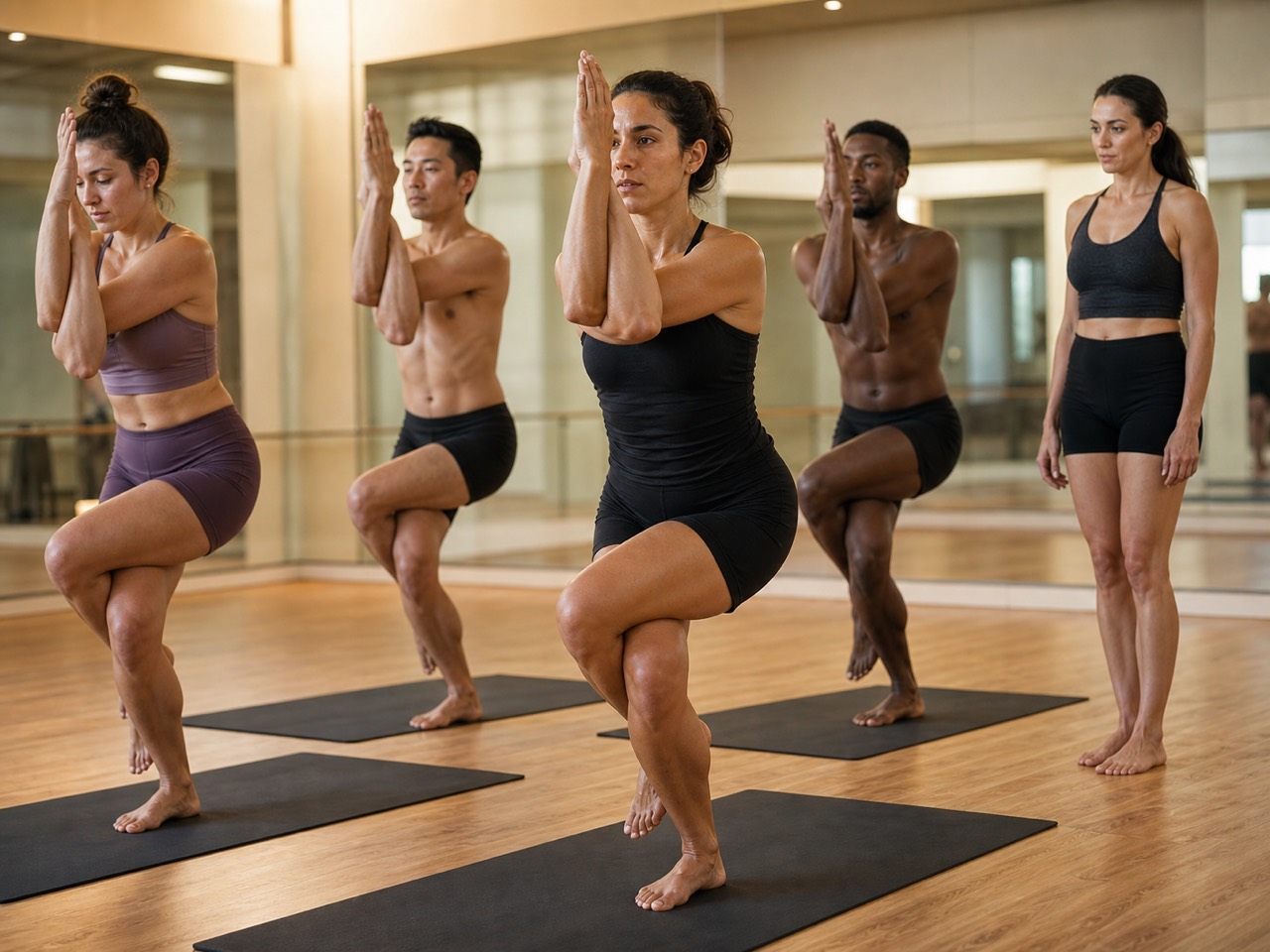
Bikram yoga poses build strength, increase flexibility, and reduce stress through a fixed sequence of 26 postures practiced in a heated room. The real Bikram yoga benefits come from repeated movement, balance, muscle effort, breathing, and focus. They do not come from claims that one posture cures a disease. This guide explains the Bikram yoga benefits of each pose in plain, practical terms.
Want every posture in order, filtered by difficulty, focus area or health benefit?
Key Bikram Yoga Benefits Across the 26 Poses
Spine health and flexibility: lateral bends, backbends, forward folds, and a final twist move the trunk through several directions. Regular controlled practice can support spinal mobility and back-body strength.
Lower-body strength: the standing series repeatedly loads the quadriceps, calves, glutes, feet, and hips while the core stabilizes the body.
Balance and body awareness: Eagle, Standing Head to Knee, Standing Bow, Balancing Stick, Tree, and Toe Stand ask practitioners to control position while attention stays on breath and alignment.
Abdominal compression and release: folds and twists change pressure around the abdomen and may create a temporary sense of digestive comfort. That said, no posture has been shown to clean out or treat an organ.
Enhanced range of motion: warmth may reduce the feeling of stiffness, while repetition provides structured mobility practice. However, heat can also hide your limits, so deeper is not always safer.
Stress and mental focus: predictable sequencing, controlled breathing, balance tasks, and Savasana can support focus and a calmer post-class state.
A controlled eight-week study found improvements in deadlift strength, lower-back and hamstring flexibility, shoulder flexibility, and single-leg balance after Bikram training. Read the peer-reviewed physical-fitness study and the broader systematic review of Bikram yoga research. Still, group results do not promise the same outcome for every person.
How the Bikram Yoga Sequence Organizes 26 Postures
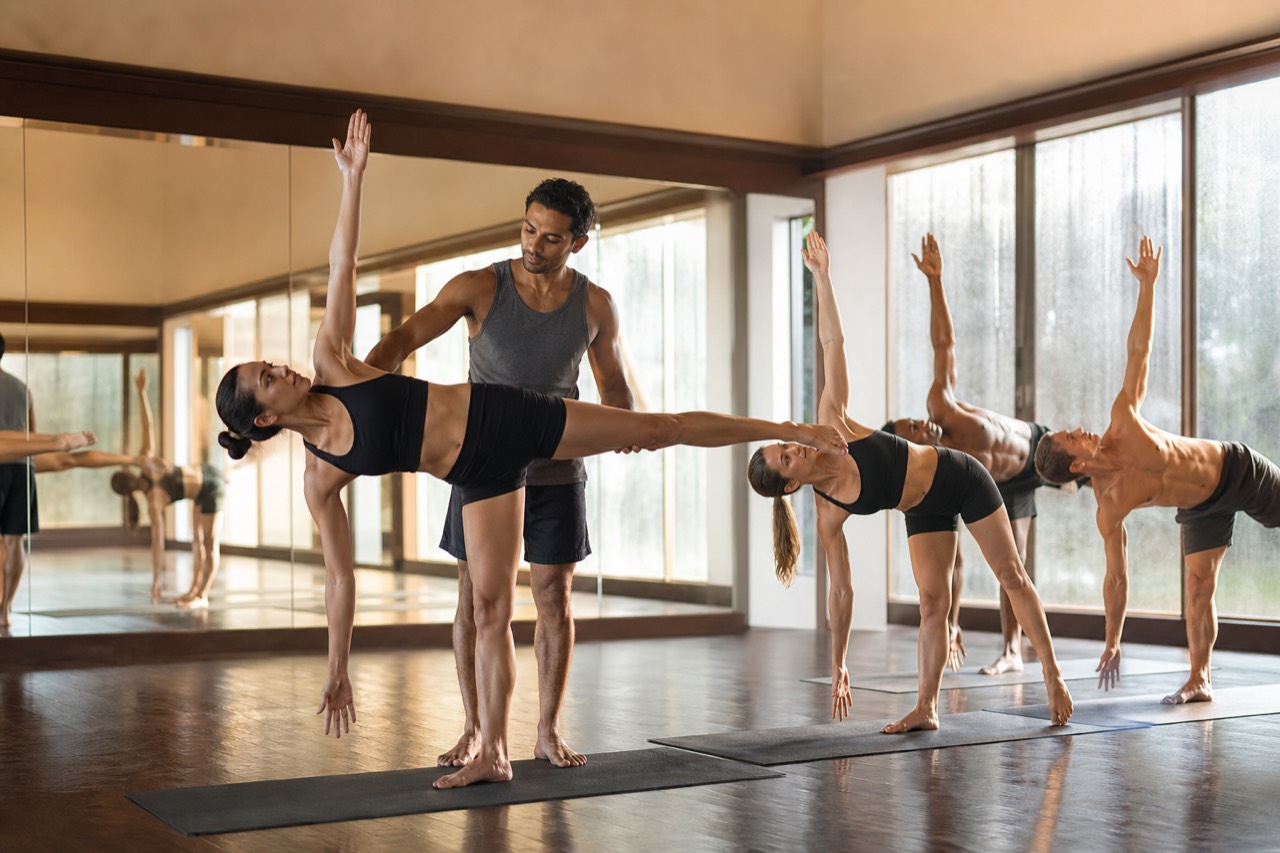
The Bikram yoga sequence uses the same positions in the same order. It begins with Standing Deep Breathing, progresses through standing strength and balance work, moves to floor postures with short recovery periods, and closes with Blowing in Firm.
The familiar shorthand is “26 postures and two breathing exercises.” In the classroom list below, Half Moon and Hands to Feet share one sequence position, while the Sit-Up transition appears as its own teaching position. This preserves the conventional numbered teaching order without printing duplicate numbers.
Because the order never changes, a student can compare one session with the next. It also lets a teacher observe how fatigue, balance, mobility, and heat response change within a familiar structure. Use the interactive Bikram yoga 26 poses guide to explore the full order, or read the complete Bikram hot yoga poses overview.
Standing Series: Bikram Yoga Positions and Benefits
The opening half develops heat, leg endurance, balance, and focus. So the Bikram yoga benefits below describe the main training demand of each position, not a medical treatment.
| Position | Primary movement | Practical benefit |
|---|---|---|
| Standing Deep Breathing (Pranayama) | Upright breathing with coordinated arm and head movement | Breath awareness, posture, rhythm, and mental preparation |
| Half Moon with Hands to Feet | Lateral flexion, extension, then a forward fold | Trunk mobility, shoulder reach, and posterior-chain flexibility |
| Awkward Pose (Utkatasana) | Three squat and heel-balance variations | Quadriceps, calves, ankles, foot control, and leg endurance |
| Eagle Pose (Garudasana) | Single-leg balance with crossed arms and legs | Balance, focus, hip positioning, and shoulder mobility |
| Standing Head to Knee | Single-leg balance with progressive knee extension and flexion | Standing-leg strength, core control, hamstring mobility, and focus |
| Standing Bow Pulling Pose | Supported single-leg backbend and hip extension | Balance, glute control, chest opening, and whole-body coordination |
| Balancing Stick (Tuladandasana) | Brief horizontal single-leg hinge | Posterior-chain strength, trunk stability, and balance under effort |
| Standing Separate-Leg Stretching | Wide-leg forward fold | Hamstring and adductor mobility with controlled weight distribution |
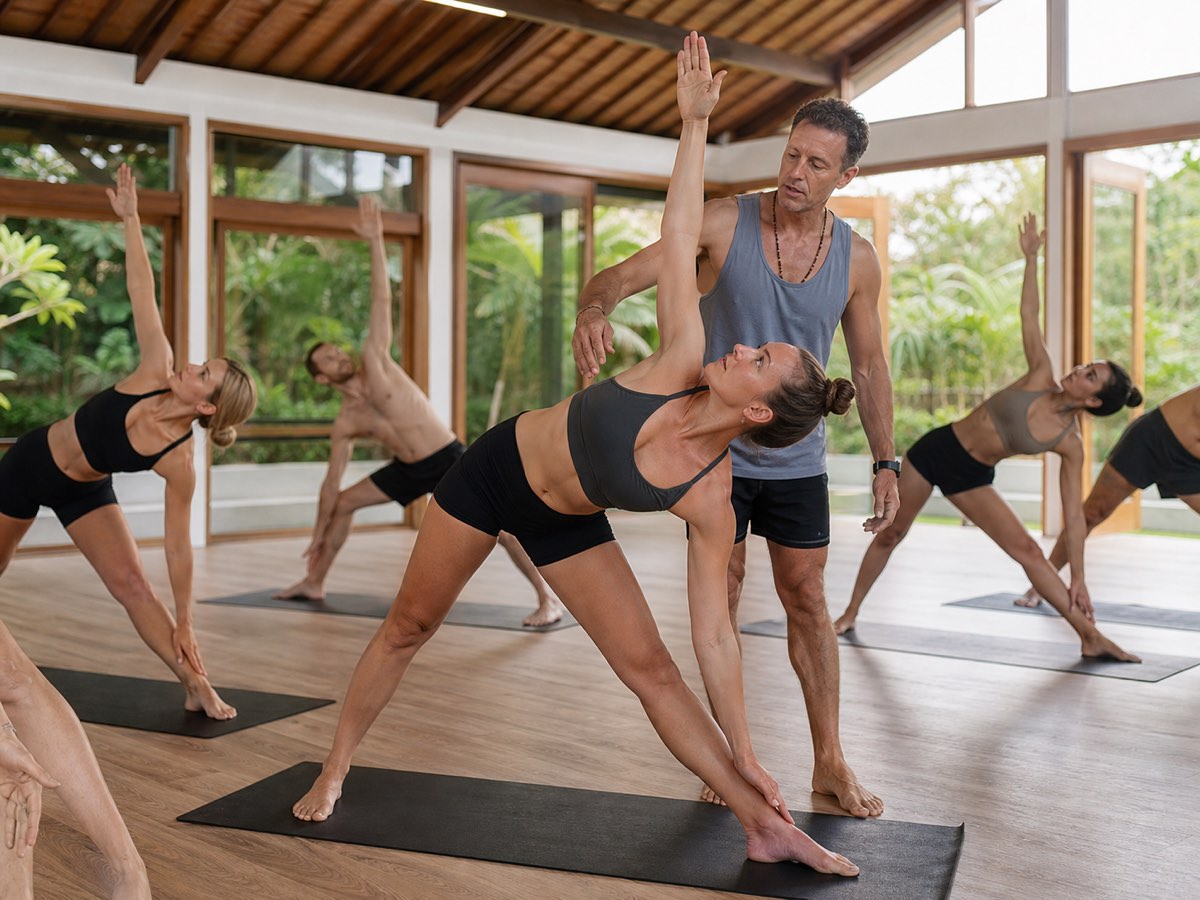
| Triangle Pose (Trikonasana) | Deep side lunge with lateral reach and rotation | Leg strength, hip mobility, trunk control, and shoulder reach |
| Separate-Leg Head to Knee | Rotated stance with spinal flexion | Hamstring mobility, abdominal control, and precise alignment |
| Tree Pose (Tadasana) | Single-leg stance with external hip rotation | Balance, upright posture, foot stability, and hip mobility |
| Toe Stand (Padangustasana) | Low balance on the forefoot | Foot and ankle control, focus, and progressive balance |
Floor Series: Benefits of Each Bikram Yoga Pose
The floor series alternates recovery, abdominal compression, spinal extension, front-body opening, flexion, and rotation. If a position causes joint pain, numbness, short breath, or dizziness, change it.
| Position | Primary movement | Practical benefit |
|---|---|---|
| Dead Body Pose (Savasana) | Supine stillness between active segments | Recovery, interoception, breathing awareness, and transition control |
| Wind-Removing Pose (Pavanamuktasana) | Single- and double-knee hip flexion | Hip mobility, abdominal compression, and lower-back relaxation for some students |
| Sit-Up | Repeated trunk-flexion transition | Trunk coordination; it should be modified for relevant back or neck concerns |
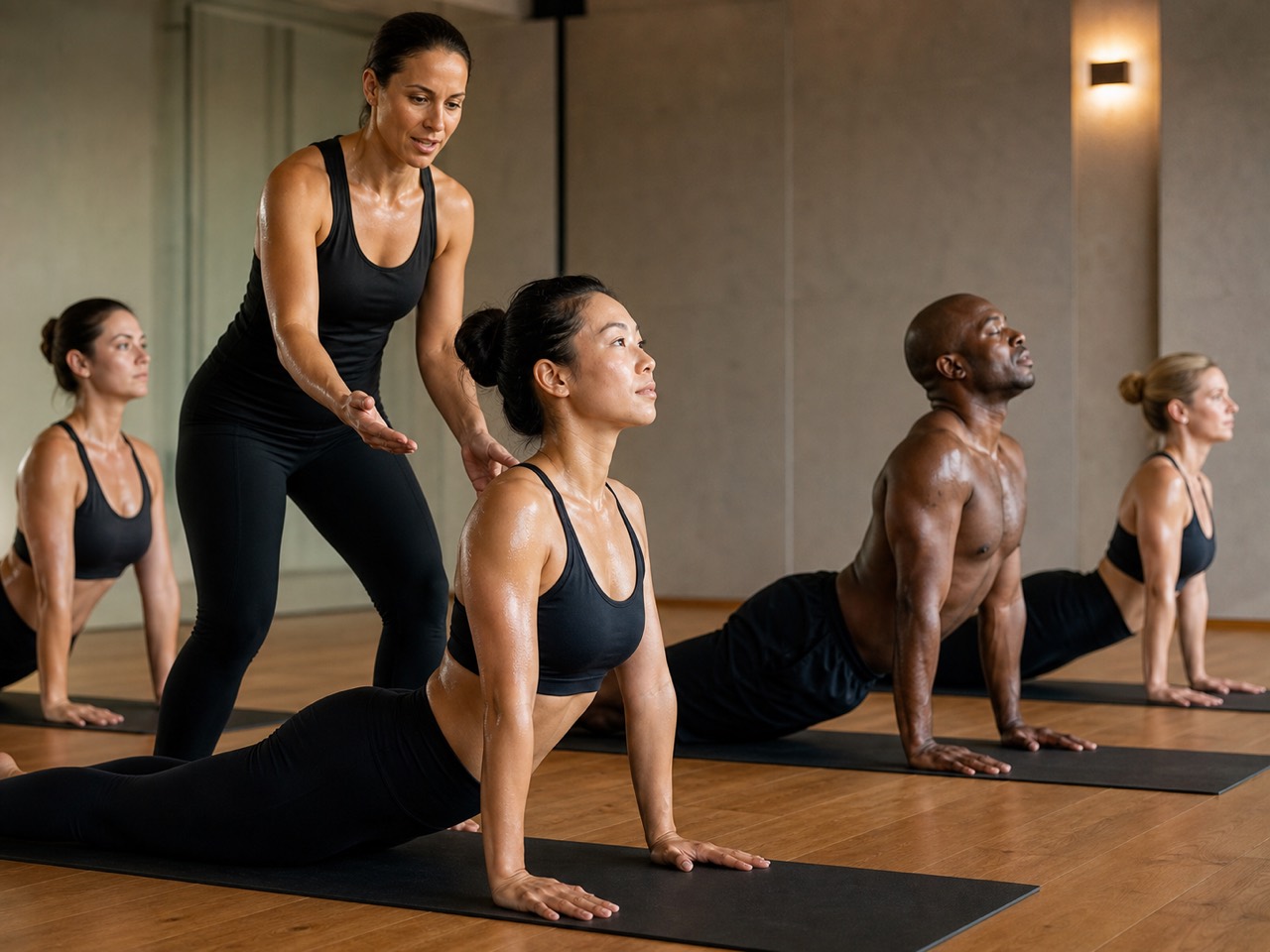
| Cobra Pose (Bhujangasana) | Prone spinal extension | Back-extensor strength, chest opening, and controlled lumbar extension |
| Locust Pose (Salabhasana) | Prone leg lifts with arm support | Glute, posterior-chain, upper-back, and shoulder effort |
| Full Locust Pose | Prone whole-body lift with arms extended | Back-body endurance and shoulder-blade control |
| Bow Pose (Dhanurasana) | Prone backbend while holding the feet | Posterior-chain strength and front-body mobility |
| Fixed Firm Pose (Supta Vajrasana) | Knee flexion with progressive recline | Quadriceps and ankle mobility; knee comfort determines the safe range |
| Half Tortoise Pose | Kneeling forward reach | Shoulder mobility, spinal lengthening, and a lower-intensity pause |
| Camel Pose (Ustrasana) | Kneeling spinal extension | Front-body opening, back-body effort, and confidence in extension |
| Rabbit Pose (Sasangasana) | Rounded spinal flexion | Upper-back mobility and a flexion counter-position after Camel |
| Head to Knee with Stretching | Single- and double-leg seated forward folds | Posterior-chain mobility, foot engagement, and controlled flexion |
| Spine-Twisting Pose (Ardha Matsyendrasana) | Seated spinal rotation | Rotational mobility, upright posture, and trunk control |
| Blowing in Firm (Kapalbhati) | Repeated active exhalations while kneeling | Breathing coordination, attention, and a defined closing ritual |
What the Heated Room Changes
A traditional class is commonly taught near 105°F (about 40.6°C) with approximately 40% humidity. Warmth can make you feel less stiff. But it also raises sweat loss and makes your heart work harder. The room does not make every position safer, burn away toxins, or justify forcing a joint beyond control.
Drink according to your needs before class, arrive prepared, and use rest when breathing, coordination, or attention deteriorates. Early scale changes after a class largely reflect fluid loss. Review the first hot yoga class preparation guide and the evidence-focused article on Bikram hot yoga benefits and limitations.
Set Realistic Expectations for Bikram Yoga Posture Benefits
How long before you notice anything? Most people feel steadier and less stiff within a few weeks. The measurable Bikram yoga benefits take longer. Bikram yoga benefits for strength and balance need weeks, not days. Studies that found clear gains in strength, balance and range of motion ran for at least eight weeks, with two or three classes a week. That is the dose to plan around. One class will tell you whether you like the room. It will not tell you what the practice does over time. Treat the first month as heat adaptation, and judge the Bikram yoga benefits after that.
Bikram yoga benefits build up from repeated, sensible training, not from one dramatic class or a single “perfect” pose. In other words, how well you practice matters more than how deep you go. Pain, confusion, faintness, chills, nausea, or loss of coordination are reasons to stop and seek help rather than proof that the method is working.
Traditional posture descriptions sometimes attach a specific organ or disease to each position. However, current research does not show that single Bikram poses cure medical conditions or “detox” organs. A more useful interpretation connects each posture with observable demands such as balance, mobility, muscular endurance, breathing, or recovery.
Beginners, pregnant students, people with cardiovascular or heat-sensitive conditions, and anyone taking medication that changes hydration or temperature regulation should get personal advice from a doctor first. A yoga teacher provides movement instruction and cannot replace diagnosis or treatment.
Learn to Teach the Bikram Yoga 26 Postures with YogaFX
YogaFX is a Bali-based option for practitioners who want to move from personal practice to professional Hot 26&2 teaching. Its hybrid pathway combines structured online preparation with a six-day practical teacher-training MasterClass in Bali.
Training covers standing and floor posture clinics, dialogue, observation, heat management, supervised instruction, and feedback. The published pathway combines Yoga Alliance RYT 200 eligibility with a method-specific Bikram Hot 26&2 certificate. Lead instructor Ian Terry, E-RYT 500, brings more than 12,000 teaching hours to the practical stage.
“The training was intense in the best possible way. I learned how to teach with confidence, understand the postures, and communicate clearly with students.”
YogaFX is an independent academy and is not official Bikram Choudhury Teacher Training. Review the Bikram Hot 26&2 certification program, see the six-day practical MasterClass, read YogaFX graduate reviews, and try the Bikram yoga pose personalizer before choosing your pathway.
Frequently Asked Questions
What are the main benefits of Bikram yoga?
The main Bikram yoga benefits are better range of motion, balance, lower-body strength and focus. You have to practise often, and at a sensible level, before much changes. Most studies that found clear gains used two or three classes a week for at least eight weeks.
What are the benefits of each Bikram yoga pose?
Each pose has its own job. Standing balances train control. Forward folds work the back of the legs and hips. Backbends build strength along the spine. The two breathing drills train attention and set the pace. The tables above list what each posture targets.
How many postures are in the Bikram yoga sequence?
A classic class holds 26 postures and two breathing exercises, always in the same order. Most postures run twice. A full class lasts 90 minutes. The fixed order is the point. You can walk into any studio that teaches it and know what comes next.
Does heat make every Bikram yoga pose more beneficial?
No. Heat makes movement feel easier and raises the load on your heart and lungs. It does not make a stretch safer, and it does not promise bigger gains. Heat can also hide your limits, so deeper is not always better. Keep your depth under control.
Which Bikram yoga positions improve flexibility?
Half Moon, Hands to Feet, Separate-Leg Stretching, Fixed Firm, Rabbit and the seated stretching sequence all work range of motion. These are the Bikram yoga benefits people tend to notice first. Build range slowly, though. A warm room can make a stretch feel safe when it is not.
Are the Bikram yoga 26 poses safe for beginners?
Many beginners do fine with slower pacing, steady fluids, easier versions of each pose and full permission to rest. Tell the front desk it is your first class. If you are pregnant, take medication, or have a heart or heat-related condition, speak to a healthcare professional first.
Where can I train to teach the Bikram yoga sequence?
YogaFX in Bali runs a hybrid route. You work through the online preparation first. Then comes a six-day in-person MasterClass intensive in Bali, built around teaching the Hot 26&2 sequence. Mr. Ian Terry, E-RYT 500, leads it. Graduates leave with Yoga Alliance RYT 200 plus a separate Bikram Hot 26 and 2 certificate.