Original Hot Yoga Association Standards From a Teacher's View: Hours, Dialogue, Internship
By Ian Terry, E-RYT 500 · Updated
The Original Hot Yoga Association (OHYA) approves hot 26&2 teacher trainings that run at least 240 contact hours, followed by a 75-class internship. For a new teacher, those standards cover hours and the dialogue well. They say little about heat safety, supervised teaching or recognition outside the association, so you need to check those points yourself.
This guide reads the Original Hot Yoga Association standards from a teacher's side of the room. We ask one question of every rule: does it prepare you to run a 90-minute class at 40°C for strangers? Mr. Ian Terry, E-RYT 500 and founder of YogaFX, has taught more than 12,000 hours.
We keep the tone neutral. The Original Hot Yoga Association is a real trade body with published rules, and we only use what it publishes plus public records. For the full records report, read the public-records report on the association.
What the Original Hot Yoga Association Standards Say
The Original Hot Yoga Association is a non-profit trade association. It sets standards for teaching the original 26-posture, two-breathing-exercise class. To see what stays fixed in that class, read our original hot yoga explained by a teacher. A training can carry the OHYA Approved seal when it meets the association's published rules.
According to the association's own teacher training page, an approved course needs a minimum of 240 programme contact hours. They split into three parts:
- 150 hours of posture lab and teaching skills.
- 80 hours of your own yoga practice.
- 10 hours of professional development.
Anatomy and physiology used to sit on top of that. Since 2025, the page says those hours can count inside the 150. The Original Hot Yoga Association also asks that the lead trainer holds OHYA Level 2 or higher and that the content stays 100% original dialogue.
These numbers are clear and easy to check. That is a real strength. Many trainings never publish their rules at all.
Hours: What 240 Contact Hours Gives a New Teacher
Hours are a useful measure because they set a minimum amount of time in front of a trainer. Still, a number alone does not tell you how those hours are spent. As a rule, quality of feedback matters more than the total. Two courses can both log 240 hours and teach very different things.
Here is how a teacher would read each block of the Original Hot Yoga Association hours:
| Hour block | What the standard says | What a new teacher still needs to ask |
|---|---|---|
| Posture lab and teaching skills (150 h) | Covers postures, teaching skills and, since 2025, anatomy | How many of these hours are you the one teaching, not watching? |
| Yoga practice (80 h) | Your own practice during the course | Is practice done in real heat, so your body learns what students feel? |
| Professional development (10 h) | Professional development during the course | Does it cover insurance, class pricing and finding your first studio? |
| Internship (75 classes) | Self-recorded after the course, signed by a senior teacher | Who finds the internship place for you, and who watches you teach? |
The last column matters most, because it turns a standard into a question you can ask. The Original Hot Yoga Association sets the floor, so the details are your job to check. The page itself says most programmes exceed these hours.
The Dialogue: Where the Association's Standard Is Strongest
The best part of the Original Hot Yoga Association standard is its rule that the content stays 100% original dialogue. A scripted class is the backbone of the method. Students hear the same words, in the same order, in every room.
That rule helps you as a teacher because it is simple. A script removes guessing. You do not invent cues under pressure. You deliver them, and your energy goes into watching the room.
Learning the script is still a skill of its own, though. It takes repetition, feedback and many practice classes. Our guide on how to memorise the hot yoga dialogue shows the methods trainees use. A good course gives you that practice inside the course, not only after it. Any school that follows the Original Hot Yoga Association dialogue rule should show you how it trains delivery.
Students notice the difference. One trainee put it like this in a YouTube review:
"It's not only the dialogue but like you're pushing me every day."
Nadya, YouTube review, 2026
The Internship: Level 1 Comes After the Last Class
The internship is the most unusual part of the Original Hot Yoga Association path. On the association's page, a graduate must complete an internship to earn the Level 1 seal. The window is not less than 6 months and up to 2 years.
Interns record their first 75 classes, and a Level 2 or Level 3 teacher signs the form after observing one class.
There is one more detail. The page says interns find their own internship, with no guarantee of a place. That is worth planning for before you enrol.
Our research report on the Original Hot Yoga Association lists the later steps too. Level 2 asks for 5 years and 1,000 classes. Level 3 asks for 10 years and 2,000 classes. Both are self-reported. So the levels reward seniority inside the Original Hot Yoga Association, and in our public-records search we found no outside body that recognises them. The same report notes that the United States does not licence yoga teachers.
| Stage | Typical timing | What you hold at that point |
|---|---|---|
| Classroom training | Set by the host school | A certificate from the training school |
| Internship, classes 1 to 75 | 6 months minimum, 2 years maximum | Directory listing as an intern |
| Teacher signs off | After 75 classes and one observed class | OHYA Level 1 seal |
| Level 2 and Level 3 | 5 and 10 years of teaching | Seniority levels inside the association |
For many new teachers, the Original Hot Yoga Association internship is a fair model. You teach real classes with a senior teacher watching. The cost, however, is time. You may wait months before the seal arrives, and your first job may not wait for it.
Heat Safety: What No Seal Replaces
The Original Hot Yoga Association hour blocks do not name heat safety as a separate topic. That gap is easy to miss, and it is the one we would close first. In a 40°C room, the teacher is the person who notices a student in trouble first.
Public health sources describe what to watch for. The NHS guidance on heat exhaustion and heatstroke lists tiredness, dizziness, headache, nausea, cramps and heavy sweating with pale, clammy skin. It describes heatstroke as a medical emergency. Signs include hot skin without sweating and confusion. For heat exhaustion, the NHS advises moving the person to a cool place and giving plenty of water.
The US Centers for Disease Control and Prevention gives a similar list. It names heavy sweating, dizziness, headaches, weakness, nausea and muscle cramping. It also tells people to take breaks and to know when to seek medical care.
Heat is not only a risk to manage, though. A 2023 randomised trial by Nyer and colleagues, published in The Journal of Clinical Psychiatry, compared 8 weeks of heated hatha yoga with a waitlist in adults with moderate-to-severe depression. The yoga group showed a significantly larger drop in clinician-rated symptoms. The groups were small, and research like this suggests benefits rather than proving them. Even so, it shows why a teacher should understand the heat well: students bring real hopes into that room.
As a result, a good training should teach you to do three things:
- Spot early signs such as dizziness, nausea and unusual quiet.
- Respond calmly by cooling the student, offering water and pausing the class for them.
- Know the limit and call for medical help when confusion or collapse appears.
These pages offer general health information, not medical advice for your own body. If you have a heart condition, are pregnant or have any other medical concern, consult a healthcare professional before you practise or train in heat.
In short, the Original Hot Yoga Association standards give you a solid base on hours and dialogue. They leave three open questions: how heat safety is taught, how much supervised teaching you get, and what the seal means beyond the association. Keep those three in mind as you compare schools.
Talk to a Studio Manager Before You Enrol
Standards matter, including the Original Hot Yoga Association rules, but the people who hire you decide what counts in practice. Because no seal is a licence, a short conversation with a local studio manager can save you months. Pick two or three studios where you would like to teach, then ask:
- Which credentials do you ask for? Some studios ask for a Yoga Alliance registration. Others care more about the style of dialogue you learned.
- Do you run an apprenticeship? Many studios let new teachers cover a few classes before they take a full slot.
- What does your insurer require? Policies differ, so ask before you pay for a course.
- How soon could I teach? The answer tells you whether a long internship fits your plans.
For example, a studio that asks for Level 1 will expect you to finish the internship first. A studio that asks for a Yoga Alliance registration will want a registered school. As a result, the right course depends on the room where you want to teach, not on the seal alone.
5 Essential Checks Before You Pay for Any Training
A seal, whether from the Original Hot Yoga Association or anyone else, is only the starting point. Treat the Original Hot Yoga Association label as one input among several. Use these five checks on every school you compare. Our guide to choosing a credible heat yoga teacher training goes deeper on each one.
- Ask who signs your certificate. Find out whether it comes from the school, a registry or both, and what each one lets you do.
- Count your teaching minutes. Ask how many classes you will teach, with feedback, before graduation.
- Ask about heat safety. Request the session plan for heat illness signs and response.
- Add up the real timeline. Count classroom weeks and any internship that follows, not just the headline course length.
- Watch the trainer teach. Ask for a full class video and read reviews written about the trainer, not only the studio.
Our article on what your hot yoga certificate actually proves explains why check one matters so much when you start applying for classes.
How the YogaFX Route Answers the Five Checks
YogaFX is independent of the Original Hot Yoga Association. We have no link to its directors or studios, so you can judge our course on its own terms, not through the Original Hot Yoga Association label. Here is how it answers each check.
Certificate and format
Certificate. The Bikram Hot 26&2 Yoga Teacher Training MasterClass gives you two credentials: Yoga Alliance RYT 200-Hour and the Bikram Hot 26&2 200-Hour International Yoga Certification. You hold both at the end of the intensive, so you do not wait for an internship before you can apply for classes.
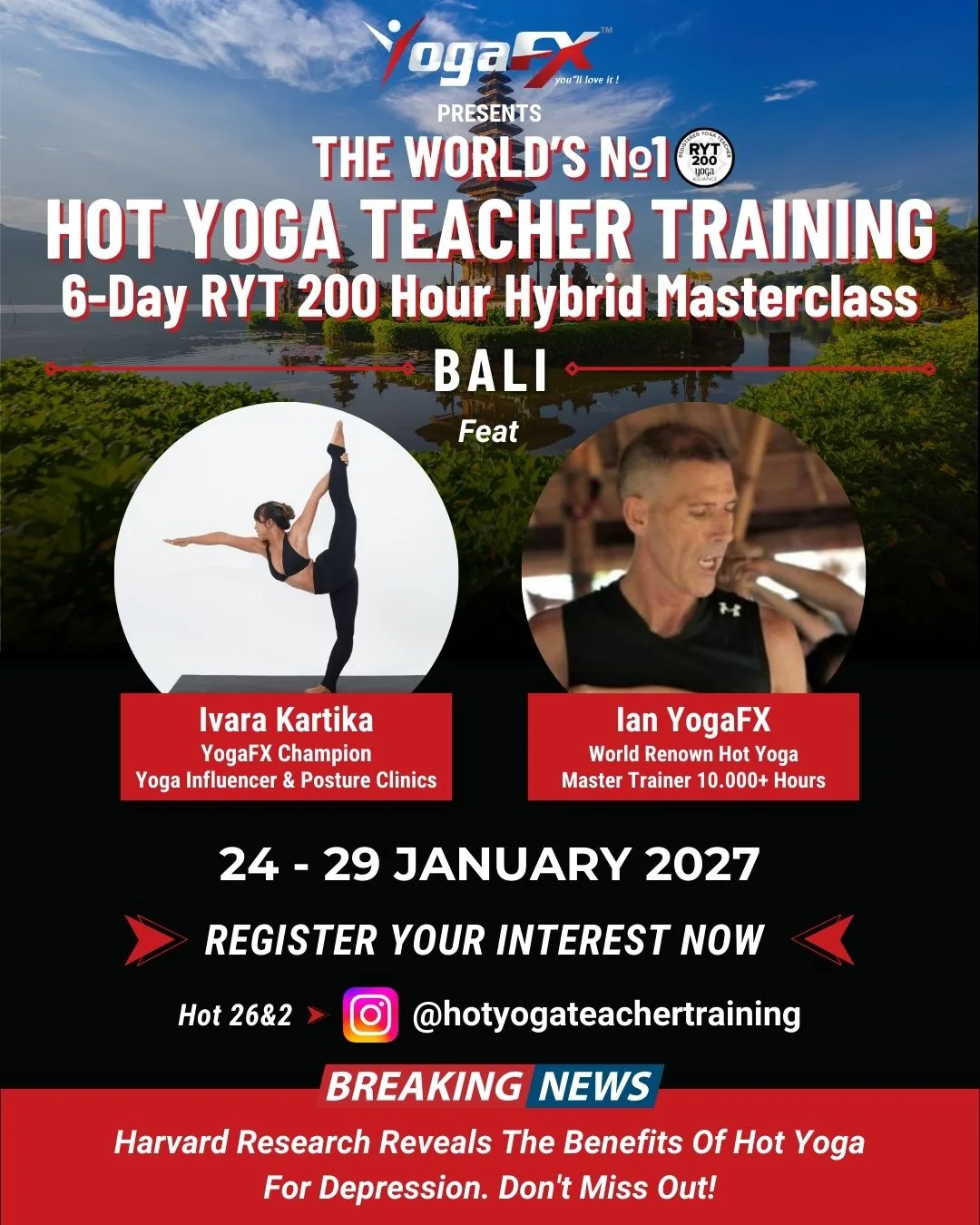
Format. The course is a six-day hybrid. You prepare online at home, then join an intensive in Bali. You check in on a Sunday and check out on a Friday, so it means just five days off work. The next batch runs from Sunday 24 January to Friday 29 January 2027 at Soham Wellness Center in Seminyak.
Trainer, heat and price
Trainer. Mr. Ian Terry is an E-RYT 500 with 12,000+ teaching hours. He trained for five years, from 2014 to 2019, with the founder of the Bikram Hot 26&2 method. In 2026 he was confirmed as Master Trainer of the Republic of Indonesia Yogasana Sports Federation.
Conditions. YogaFX studio classes run for 90 minutes at 40°C and 40% humidity, with natural tropical heat. You learn to teach in the conditions the method was built for.
Price. The Early Bird price is US$1,899, against a normal US$1,999. Payment plans start from US$250 a month with no interest. Compare that with any other quote by adding every fee, including any internship costs.
More than 1,500 teachers from over 80 countries have trained with YogaFX since 2017. Two of them wrote the following words in public reviews.
"The training and advice he gave is utterly applicable to a real world teaching environment."
Amanda, Yoga Alliance review, 2019
"What an amazing training! I would highly recommend everyone do this training whether you want to be a teacher or not. It's life changing."
Peter, Google review, 2025
Those sit among 150 Google reviews, 50 Yoga Alliance reviews and 357 video testimonials on YouTube. To see how the full programme is built, read our 200-hour hot yoga teacher training curriculum and the programme page.
FAQ
What does OHYA Approved mean for a new teacher?
It means the training says it meets the Original Hot Yoga Association's own standards: at least 240 contact hours, original dialogue and a lead trainer at Level 2 or higher. It is a private standard for one method. You should still check heat safety teaching and outside recognition yourself.
Do I have to finish an internship after the training?
Only if you want the Original Hot Yoga Association Level 1 seal. That needs 75 recorded classes over at least 6 months, signed off by a senior teacher. Other routes, such as a Yoga Alliance registered course, can give you a certificate when the classroom part ends, with no internship wait.
What should a hot yoga teacher know about heat illness?
Teachers should know the early signs: dizziness, nausea, headache, cramps and heavy sweating. Heatstroke, with hot dry skin or confusion, is a medical emergency. The NHS advises moving the person to a cool place and giving water. Always ask your school for its heat safety session plan.
How do I compare two hot yoga teacher trainings fairly?
Use the same five questions for both: who signs the certificate, how many classes you teach, what the heat safety plan is, the full timeline including any internship, and reviews of the trainer. Write the answers side by side, then compare price and format last.
Where can I train in the Original Hot 26&2 method in Bali?
YogaFX runs the Bikram Hot 26&2 Yoga Teacher Training MasterClass, a hybrid course with online preparation and a six-day intensive. The next batch is Sunday 24 January to Friday 29 January 2027 at Soham Wellness Center, Seminyak. It leads to Yoga Alliance RYT 200 and a Bikram Hot 26&2 certification.
Still have questions? Message Mr. Ian and the YogaFX team on WhatsApp and we will answer them personally.