Hot Yoga Certification: What Your Teaching Certificate Actually Proves
By Ian Terry, E-RYT 500 · Updated
A hot yoga certification proves only what its issuer can back up. A school certificate shows you finished that school's course, a registry listing shows the school met a published standard, and an association seal shows membership. None of them proves you can teach in a heated room until you have taught one.
This guide is written from the teacher's side of the room. Mr Ian Terry, E-RYT 500, leads the YogaFX trainings in Bali, and we watch graduates show their certificates to studio owners. Studios rarely ask "how many hours?" first. They ask what the paper proves and who stands behind it. That holds for a hot yoga instructor certification or a Bikram yoga teacher certification alike.
What a hot yoga certification actually proves
Most people treat a hot yoga certification as one thing. In practice it is up to three different documents, and each one answers a different question. Mixing them up is the most common mistake we see before a student pays a deposit.
The first document comes from the school. The second is a registry listing, which sits outside the school. The third is an association seal, which a school may or may not hold. Read them in that order, because each layer checks the one before it.
The three layers side by side
Here is how the three layers compare:
| Layer | Who issues it | What it proves | What it cannot prove | Question to ask |
|---|---|---|---|---|
| School certificate | The training school | You finished that school's course | That anyone outside the school checked the standard | Who is the named lead trainer? |
| Registry listing | An outside registry | The school met the registry's published standard | How well the school teaches the heat | Can I find the school in the directory myself? |
| Association seal | A trade or method body | The school belongs to the group, or meets its rules | That anyone audited the teaching | Who set the standard, and who checks it? |
| Live dialogue test | The school's trainers | You can deliver the dialogue to real students | Your results in a studio you have not met | How many classes will I teach, with feedback? |
| Heat safety module | The school's trainers | You can name heat illness signs and respond | Medical skill beyond first response | Which signs and steps are on the syllabus? |
Notice the last column. A good hot yoga certification survives all five questions. A weak hot yoga certification falls apart at the second or third. As a result, the table is a better shopping tool than any star rating.
Layer one: the school certificate
The school certificate is the paper you hold on graduation day. It says you finished that school's course, and that is all it says. Its value depends entirely on the school's name, its trainers and its teaching hours.
So what should it state in plain words? Look for these four things:
- The issuer. One named school, not a vague "academy network".
- The course. Hours, format and the method you trained in.
- The date. Studios want to see when you finished.
- A named lead trainer. Someone a studio owner could phone.
A hot yoga teacher certification that fails any of these is hard to read in ten seconds. Studio owners are busy, so a clear certificate helps you more than a long one. If you want the full course breakdown behind a certificate like this, our guide to the Bikram hot yoga course covers the curriculum, cost and what each day contains.
Layer two: the registry listing
A registry is a list kept by an outside body. Yoga Alliance is the one most of our graduates use. Its page for schools says that becoming a Registered Yoga School "lets your graduates register as RYTs" and signals that the program meets its standards. In other words, the registry checks the school, and then the graduate registers on the strength of the school's training.
For a new teacher, Yoga Alliance describes the Registered Yoga Teacher level as the foundational 200-hour training, and says most new teachers begin with it. Once you graduate, you submit an application with your training certificate. You can read the details on its training options page.
Now the practical part. Do not trust a logo on a website. Instead, run the check yourself:
- Open the Find a Yoga School directory.
- Select the designation, for example RYS 200, and search the school's name.
- Compare the name on the listing with the name on the certificate you will receive.
That takes three minutes for any hot yoga certification. It also separates a hot yoga certification you can verify from one you must simply believe. Search results sometimes call the same fixed-sequence training a Bikram yoga certification, so check the school's name, not the label.
Because a registry listing is only one layer, it still says nothing about how the school teaches the heat. That is why the other two layers matter.
Layer three: the association seal
Some schools display a seal from a trade association or a method body. A seal can be useful, but it is the easiest layer to misread. It usually shows membership. It may not show that anyone audited the teaching.
Ask three questions before a seal changes your decision:
- Who set the standard? A published standard beats a private one.
- Who checks it, and how often? An annual audit means more than a one-time signup.
- Can I read it? If the standard is secret, the seal proves little.
A seal is a bonus, not a foundation. A hot yoga certification with a registry listing and a named trainer but no seal is usually stronger than the reverse. In our experience, a hot yoga certification is the end of a conversation, not the start of one.
Before the next section, here is the whole check on one screen.
Why a hot yoga certification should test the dialogue
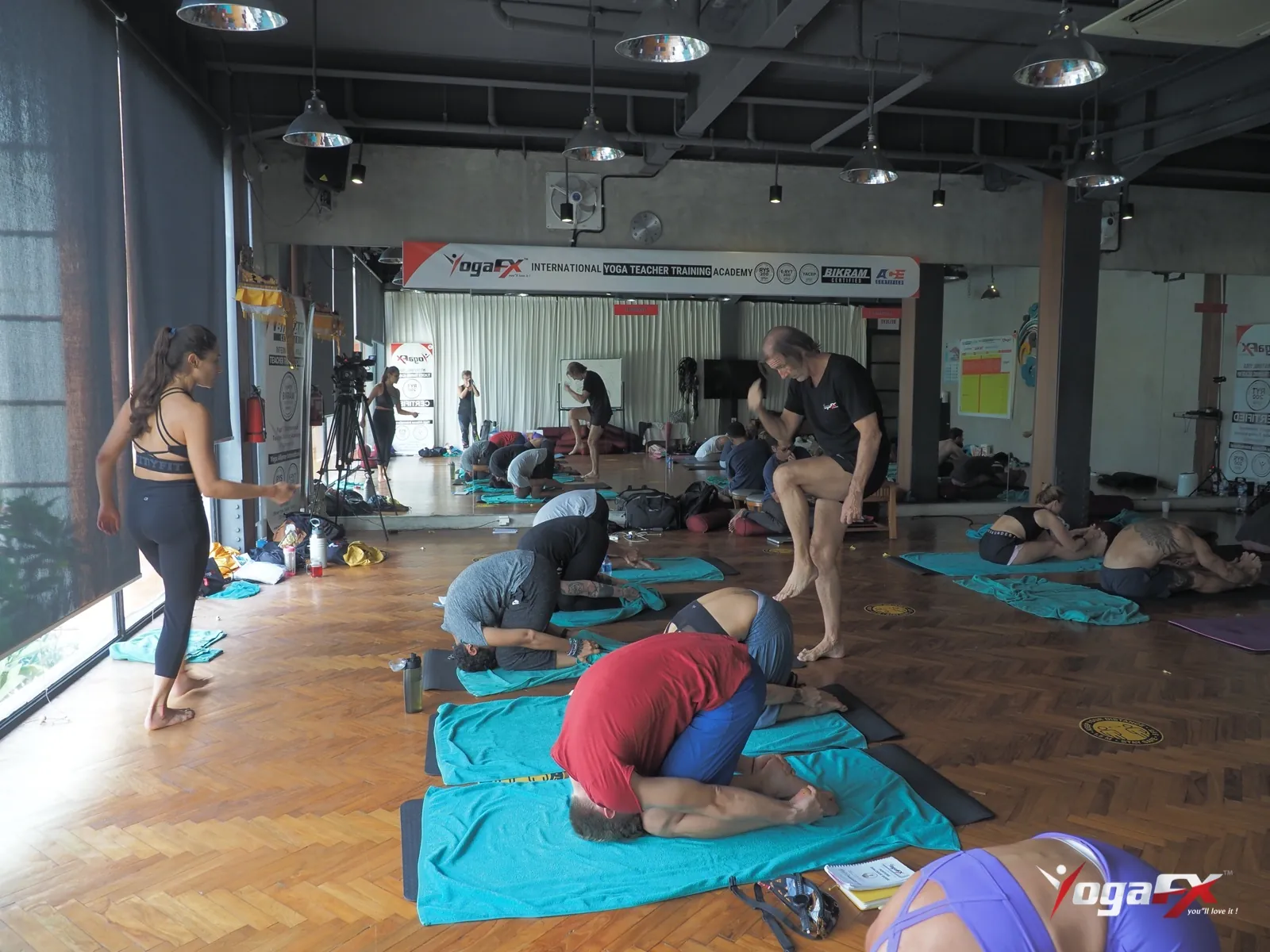
In an Original Hot 26&2 class, the same 26 postures and 2 breathing exercises are taught every time. The teacher speaks a scripted dialogue. There is no demonstration and no music, so your voice carries the whole room. That is why a hot yoga certification for this method has to test your delivery, not just your memory.
What does a real assessment look like? There are three signs:
- Live delivery. You teach the dialogue aloud, not on a quiz sheet.
- Real students. Practice classes include people who are not your classmates.
- Feedback you can act on. Someone marks where the words slipped, and you teach again.
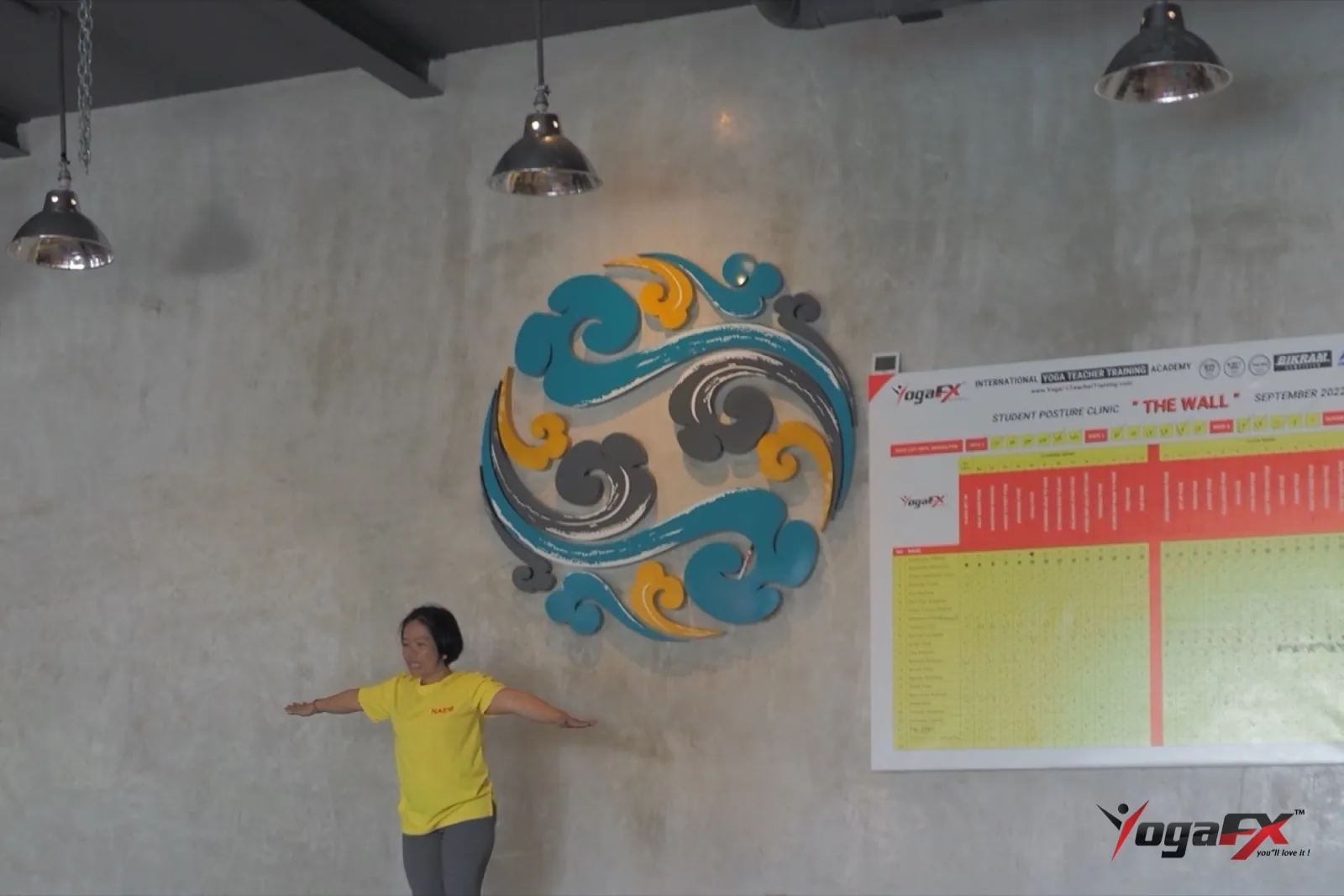
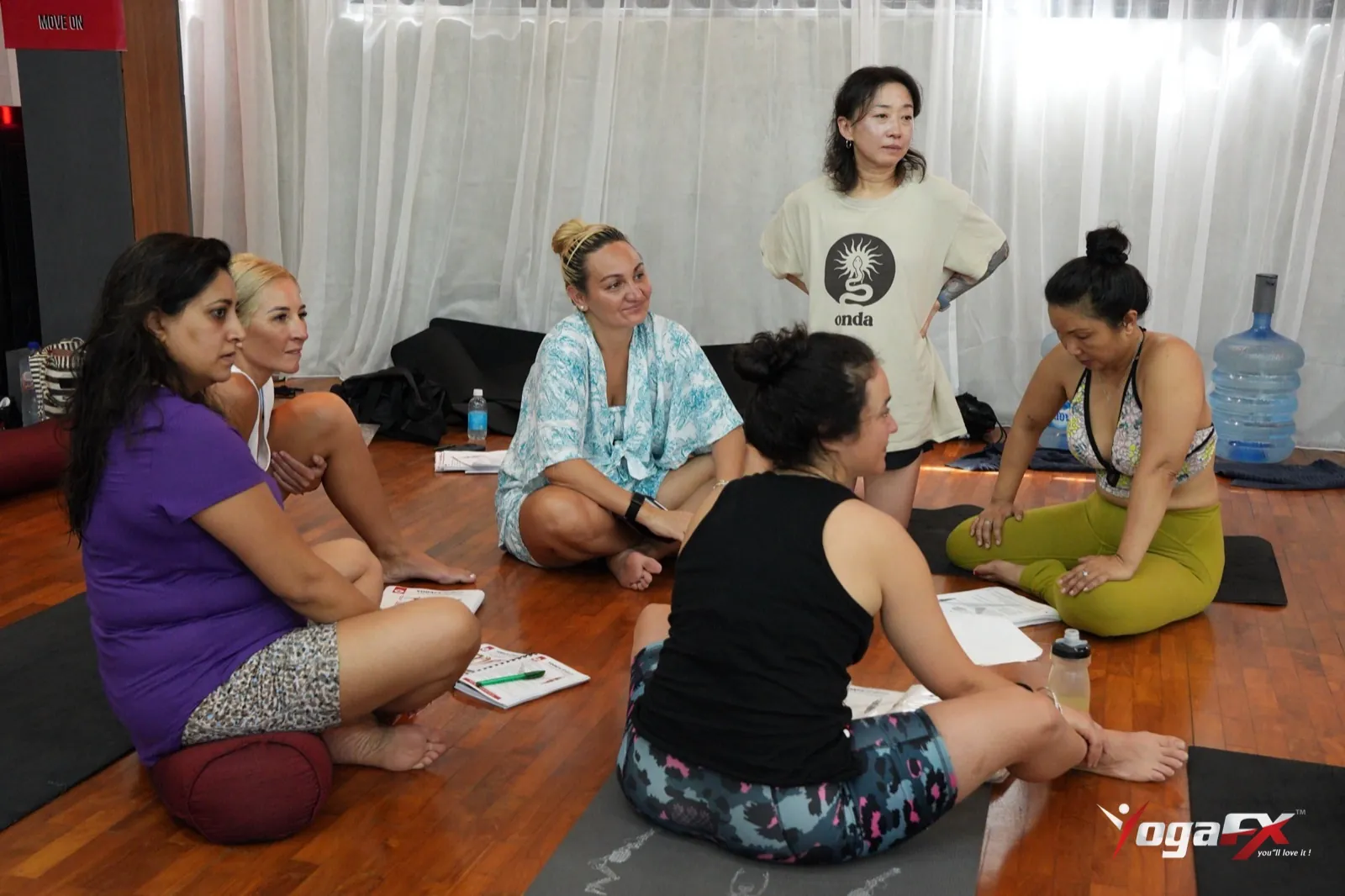
At YogaFX, trainees teach real students in supervised classes in natural tropical heat, about 40°C with 40% humidity. The posture clinic wall in the studio is a chart that tracks trainees' progress through the postures, so nobody guesses where they stand.
Practise the cues first with the Dialogue Flashcards
Memory comes before delivery, so we built a free tool for it. It suits anyone preparing for a hot yoga certification. The Bikram Yoga Dialogue Flashcards page is a 26-card deck. Each card shows a posture's English and Sanskrit name, plus a short Dialogue Study Cue on the back.
Here is how to use it well:
- Pick Standing Series or Floor Series, or stay on the full deck.
- Read the posture names, then try to recall the cue out loud.
- Press Flip to check yourself, and Shuffle when you know the order too well.
Be clear about its limits. The page itself says the cards do not replace the complete training dialogue, live feedback or supervised teaching. They help you study. They don't assess you.
What the research says about teaching in heat
A hot yoga certification should include heat safety, and the evidence for why is straightforward. The NHS lists the signs of heat exhaustion as tiredness, dizziness, headache, nausea, heavy sweating with pale, clammy skin, cramps, a high temperature and strong thirst. It describes heatstroke as a medical emergency, with very high temperature, hot skin without sweating, fast breathing, confusion or a seizure (NHS: heat exhaustion and heatstroke).
A teacher who can't name those signs shouldn't hold a class, and a hot yoga certification without a heat safety module leaves a gap. The same NHS page notes that older people, children and people with long-term conditions such as diabetes or heart problems are at higher risk. Those students may walk into your room on day one.
Research on heated classes is growing too. A randomised trial in the Journal of Clinical Psychiatry gave heated hatha yoga to adults with moderate-to-severe depression. Of the 65 people analysed, 59.3% of the yoga group had at least a 50% drop in symptoms, against 6.3% on the waitlist (Nyer et al., 2023, full text on PubMed Central).
That result is promising, but it does not make a yoga teacher a therapist. The trial studied one eight-week programme, so it cannot promise the same effect for any individual.
For you as a future teacher, the lesson is practical. Some students will arrive with serious health histories, so your certificate should teach you when to refer them on. If you have a health condition, consult a healthcare professional before practising in a heated room.
Red flags on a hot yoga certification page
Most sales pages look convincing at first glance. Teachers who have reviewed many of them tend to spot the same warning signs. None of these proves a school is bad, but each one is a reason to ask more questions.
- No named trainer. If the page shows only stock photos, you cannot check who will teach you.
- A seal with no standard behind it. A badge you cannot click through is decoration.
- No live teaching. A hot yoga certification built only on videos cannot test whether you can lead a room.
- No heat safety on the syllabus. Hydration, thermoregulation and the signs of heat illness should be listed.
- Pressure to pay today. Countdown timers are a sales tactic, not proof of quality.
Because a hot yoga certification follows you for years, a short email to the school is cheap insurance. Ask who the lead trainer is, how many classes you will teach, and where the school is listed. A school that answers clearly in writing is usually a school that teaches clearly too.
What a certificate does not do after graduation
Finishing the course is step one, and a hot yoga certification does not do the rest for you. Most graduates follow the same short path:
- Register. If you trained at a registered school, apply to the registry with your training certificate.
- Insure yourself. Get cover before you teach paying students.
- Audition. Studios often ask for a sample class, sometimes with the dialogue in full.
- Keep learning. Our guide to yoga continuing education explains how hot yoga teachers plan the next step.
Teaching is not the goal for everyone, and a hot yoga certification can also serve your own practice. Some graduates take the course to deepen their own practice and never audition anywhere. Both paths are fine, and the same documents serve both.
What graduates say about their certificate
We don't ask anyone to take our word for it. Across Google (150 reviews), Yoga Alliance (50 reviews) and YouTube (357 video testimonials), more than 550 students have shared their experience. These are short excerpts, shown with first names only.
"It's not only just about getting the certification. I think it's just the connections we've all made."
Mayuri, YouTube review, 2026
"Learnt the difference between getting into the posture and getting into the posture in the right way"
Deimante, Google review, 2019
"Mr. Ian is one of the best teachers, I have ever met"
Ritesh, Google review, 2019
Mayuri's video below shows her graduation day, including the moment she receives her certificate.
How a hot yoga certification fits a wider shortlist
Not every reader is ready to commit. If you are still comparing, the shortlist on our teacher training hub sets out how the main hot yoga certifications are built, so you can compare like with like. This page stays on one narrower question: what each document proves.
Put simply, use the three layers as a filter for any hot yoga certification. First, confirm the school certificate names the course and the trainer. Second, verify the registry listing yourself. A hot yoga certification you cannot verify is just a PDF. Third, treat any seal as a bonus. Then decide whether you want a fixed sequence or a freestyle format, because that choice decides which studios will hire you.
Where YogaFX fits
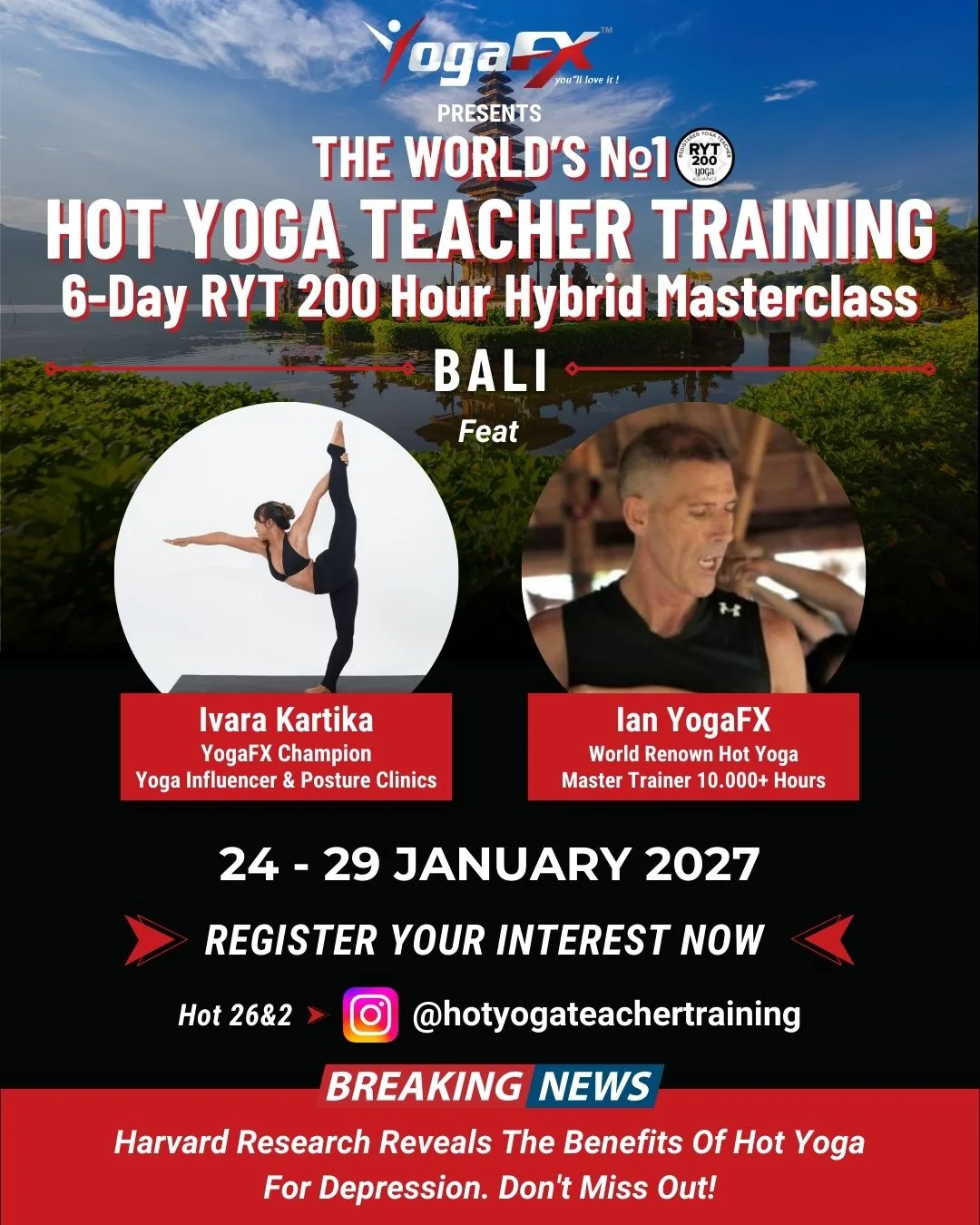
The YogaFX MasterClass is a six-day hybrid course: self-paced online study first, then an intensive in Seminyak, Bali. Check-in is on Sunday and check-out is on Friday, so most students need only five days off work. Graduates leave with a Yoga Alliance RYT 200 route plus the Bikram Hot 26&2 200-Hour International Yoga Certification.
Mr Ian Terry holds E-RYT 500 and has more than 12,000 teaching hours. He trained for five years, from 2014 to 2019, with the founder of the Bikram Hot 26&2 method, and he is a Master Trainer for the Republic of Indonesia Yogasana Sports Federation. Since 2017, YogaFX has trained more than 1,500 teachers from over 80 countries.
The next batch checks in on Sunday 24 January 2027 and checks out on Friday 29 January 2027 at the Soham Wellness Center in Seminyak. Dates can change, so confirm them with the team first. For the full programme, prices and what is included, see the YogaFX teacher training programme page. Our guide to original hot yoga teacher training explains how the curriculum is built.
FAQ
How does hot yoga certification work?
You train at a school, finish its course, and receive the school's certificate. If the school is registered with a registry, you then apply to register as a teacher using that certificate. Studios will also want proof you can teach the heated method, so a live teaching assessment matters.
What is the difference between a school certificate and a registry listing?
A school certificate comes from the school and proves you finished its course. A registry listing comes from an outside body and shows the school met a published standard. You need to check both. The first tells you what you learned, and the second tells you who verified it.
Can you get a hot yoga certification online?
Partly. Theory, anatomy and memorising the dialogue work well online. However, a screen cannot show whether you can lead a class in the heat. Ask any online course how it assesses live teaching. At YogaFX, you study online first, then teach real classes in Bali.
How long does it take to get a hot yoga certification?
It depends on the format. A 200-hour course can run full-time over weeks or part-time over months. The YogaFX MasterClass is hybrid: self-paced online study, then six days in Bali. Check-in is Sunday and check-out is Friday, so most students need five days off work.
Is YogaFX official Bikram Choudhury Teacher Training?
No. YogaFX runs independent training, not official Bikram Choudhury Teacher Training. Mr Ian Terry trained for five years, from 2014 to 2019, with the founder of the Bikram Hot 26&2 method, and the school issues its own Bikram Hot 26&2 200-Hour International Yoga Certification to graduates.
How much does a hot yoga certification cost?
Price depends on the school, the format and the length. Add flights, accommodation and time off work when you compare. The YogaFX MasterClass starts from US$1,899 at the Early Bird rate, and interest-free instalments start from US$250 a month. See the programme page for current options.
Still have questions? Message Mr Ian and the YogaFX team on WhatsApp and we will answer them personally.