Should You Do a Hot Yoga Teacher Training? Pros, Cons, and Red Flags
By Ian Terry, E-RYT 500 · Updated

You should consider hot yoga teacher training if you want disciplined study, are prepared for repeated feedback, can work responsibly in heat, and understand that certification begins rather than completes your development. You should pause if you are chasing a guaranteed job, a rapid personal cure, or a certificate without teaching practice. The honest answer depends on your purpose, health, finances, schedule, and the quality of the program.
Who Hot Yoga Teacher Training Suits
Training suits the practitioner who keeps asking why. Why this sequence? Why these words? Why does one student respond differently? Curiosity turns repetition into study. If you enjoy observing details and explaining them with patience, teaching may give your practice a useful new direction.
Career changers can benefit when expectations are realistic. Yoga teaching may become one part of a portfolio career, a route into studio work, or a long-term profession built gradually. Income varies by market, class type, experience, availability, and business skill. A six-day intensive cannot guarantee a salary, but it can establish a teaching foundation and reveal the work still ahead.
Serious practitioners who do not plan to teach may still find value. Dialogue practice exposes gaps in understanding. Anatomy gives language to movement. Philosophy tests why you practise. Teaching classmates develops empathy for the person at the front of the room. You must be willing to complete professional assignments even if your final goal remains personal.
Training may not suit you now if your practice is inconsistent, your health response to heat is uncertain, or your calendar leaves no study and recovery time. Postponing is not failure. A few months of consistent classes and financial planning can turn an impulsive application into a sustainable commitment.
It also may not suit someone seeking external validation through physical performance. The most flexible person is not automatically the clearest teacher. Programs should reward attention, responsibility, communication, and coachability rather than only advanced-looking postures.
Potential Benefits of Training
The clearest benefit is structured attention. Instead of attending class and moving on, you examine sequence, language, anatomy, ethics, and teaching decisions. Repetition becomes deliberate. You learn where your knowledge is stable and where you have relied on habit.
Communication often changes. Trainees practise giving one instruction at a time, removing filler, projecting without hostility, and watching whether words work. Those skills can carry into work and relationships, although a teacher training should not promise a total life transformation.
Research suggests heated yoga may be associated with outcomes in areas such as flexibility, strength, and mental health, but evidence varies and does not guarantee individual results. A 2023 randomised trial reported promising preliminary findings for heated hatha yoga and depression symptoms. Read the Nyer et al. trial. Teachers must keep professional scope clear and avoid medical promises.
Community can be another benefit. Intensive learning reveals how people respond to fatigue, correction, uncertainty, and progress. Supportive classmates may become practice partners or professional contacts. Community is healthiest when the program allows disagreement, rest, and personal boundaries rather than demanding loyalty.
A credential can open auditions or satisfy a studio's baseline requirement, but it does not replace teaching quality. The deeper benefit is leaving with a repeatable way to prepare, teach, review, and improve.

The Physical and Professional Reality
Hot yoga training can involve long days of practice, lectures, dialogue, peer teaching, and feedback. Teaching while warm is different from practising while warm. You must continue observing and speaking as concentration drops. Preparation should include consistent classes, sleep, sensible nutrition, and experience managing your own response without drama.
Heat does not make unsafe behaviour virtuous. If you have a health condition, are pregnant, take medication that affects heat response, or are uncertain about intense heated exercise, consult a healthcare professional. A program should explain hydration, acclimatisation, warning signs, rest, and exit procedures. Confusion, chest pain, faintness, or severe distress must not be treated as weakness.
Teaching reality includes less glamorous work: arriving early, cleaning, checking the room, learning names, handling payments or attendance, covering classes, maintaining insurance, and responding professionally to complaints. Ask graduates about these routines. A career is built through reliability as much as inspiration.
You will also be corrected. Useful training is not designed to protect your self-image. It should challenge habits while preserving dignity. Feedback needs to be specific, relevant, and connected to another attempt. Humiliation, intimidation, or pressure to accept inappropriate conduct is not rigorous education.
One graduate experience described in the academy's review record began with fear and ended with a strong sense of accomplishment. That arc is common, but it should not be sold as proof that fear is always wrong. Good training helps you distinguish normal nerves from a genuine boundary.
Costs and Trade-offs
Training costs money, time, and energy. Tuition may exclude travel, accommodation, meals, manuals, assessment, registration, insurance, or resits. Calculate the full amount before paying. If you reduce work hours, include missed income. Financial pressure can make an otherwise good course difficult to complete.
An intensive compresses learning. The focus can be powerful, but you have less time to recover between corrections. A long local course spreads the load but competes with normal responsibilities for months. Hybrid study balances flexibility and immersion, yet requires self-discipline before the practical stage.
Certification does not guarantee confidence. Some graduates feel ready to audition immediately. Others need practice classes, mentoring, and observation. Ask what post-course support exists and whether you can continue using course materials.
There is also opportunity cost. The same resources might fund a different method, anatomy specialisation, business education, or months of personal practice. Define the decision you are making now rather than trying to choose a credential for every possible future.
Review the complete training cost breakdown and online versus hybrid format analysis before deciding.
Program Red Flags
- Guaranteed jobs, income, healing, or transformation.
- No named lead trainer or unclear access to that person.
- No supervised teaching or competence-based assessment.
- Pressure to pay before receiving curriculum and refund terms.
- Heat framed as punishment or rest framed as failure.
- Unclear certificate wording or unsupported claims of recognition.
- Hidden charges for materials, assessment, or certification.
- Health claims that rely on detox language or ignore professional scope.
Red flags are patterns, not always isolated wording. A new staff member may answer one question poorly. Give the school an opportunity to clarify in writing. If clarity remains unavailable after specific questions, trust the evidence.
Look for positive signals too: detailed schedule, trainer biographies, small enough practicum groups, published assessment, transparent pricing, direct graduate access, healthcare disclaimers, and a culture that allows questions.
One academy graduate described discovering the difference between being a capable practitioner and becoming a responsible teacher. That is a healthy training outcome because it replaces assumption with respect for the job.

The YogaFX View
Mr. Ian Terry describes teacher development through repetition and direct correction. He holds E-RYT 500 credentials, has more than 12,000 teaching hours, completed five direct training sessions under Bikram Choudhury from 2012 to 2019, and has trained 1,500+ graduates from over 80 countries. In June 2026 he was confirmed as Master Trainer of the Republic of Indonesia Yogasana Sports Federation.
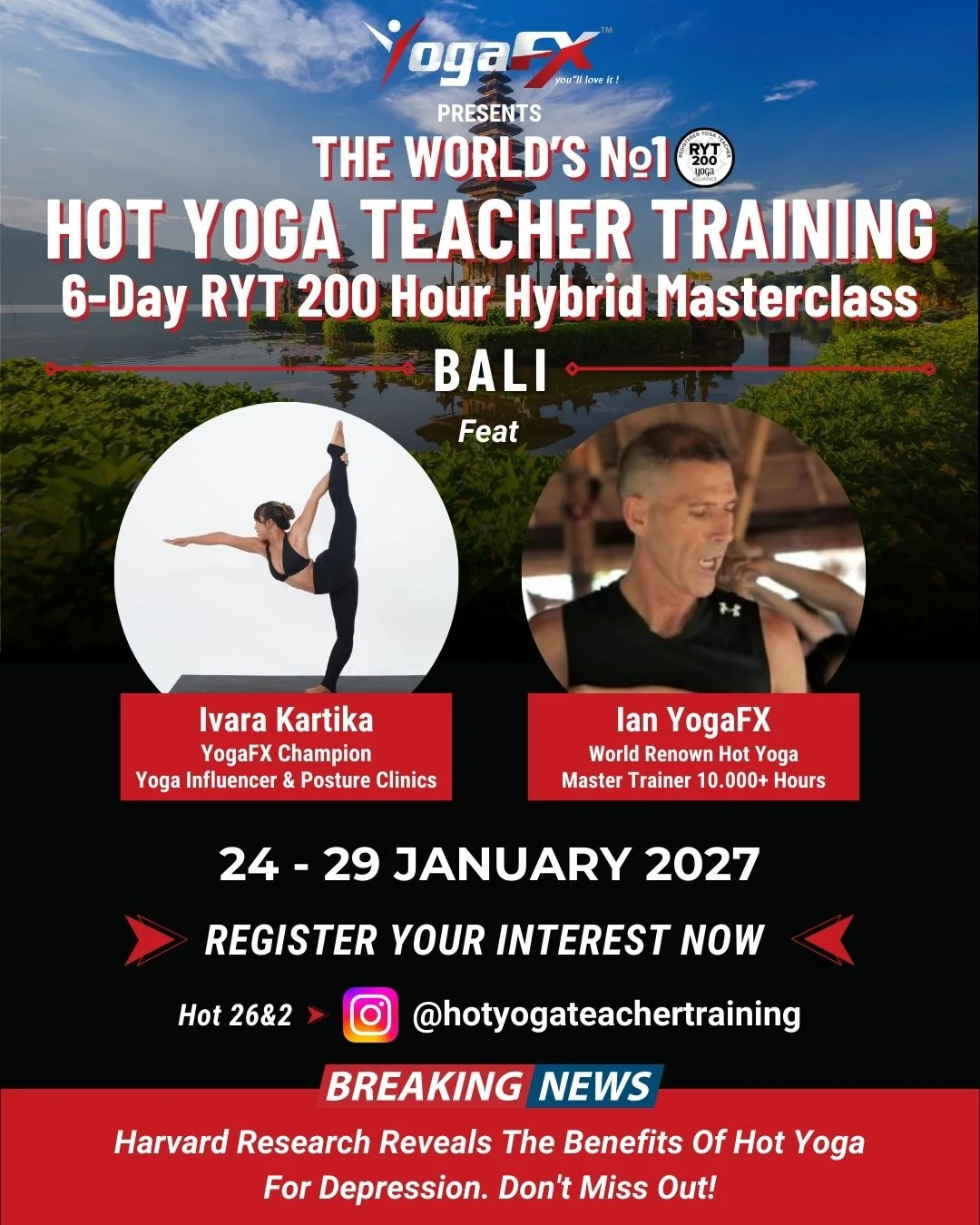
The YogaFX pathway has operated since 2017. It combines online preparation with a six-day Bali intensive, caps cohorts at 19, costs USD 1,699 flat, and awards RYT 200 plus Bikram Hot 26&2 certification after successful completion.
Training follows Original Hot 26&2 Yoga: a 90-minute sequence of 26 postures and two breathing exercises, delivered through scripted verbal dialogue without demonstration or music. Studios in Seminyak and Canggu use natural tropical heat at about 40°C and 40% humidity, never electric heaters, and operate from 06:00 to 22:00 daily.
Read the complete selection guide, then compare the 200-hour curriculum. If the demands and outcomes fit you, inspect the YogaFX program details and speak with Mr. Ian Terry directly.
A readiness conversation with yourself
Write down what you want training to change and separate outcomes you control from those you do not. You can control preparation, attendance, practice, openness to feedback, and professional conduct. You cannot control guaranteed employment, income, other people's approval, or a dramatic personal breakthrough. A course is easier to evaluate when it is not carrying every hope at once.
Review your last three months of practice. Consistency matters more than one heroic week. Notice how you respond when tired, corrected, or unable to perform a posture as expected. Teacher training will bring those reactions closer to the surface. You do not need to eliminate them first, but you should be willing to observe them without making classmates responsible for your response.
Talk with the people affected by your schedule and budget. Intensive study may change work, family, childcare, or travel arrangements. Clear support plans reduce avoidable stress. If the course is local and spread over months, protect recurring study time rather than assuming it will appear.
Set a walk-away condition before speaking with sales staff. It might be missing assessment detail, refusal to provide refund terms, a cohort above your limit, or pressure around health. Deciding in advance makes it easier to recognise when excitement is overriding your standards.
Ask someone who knows your schedule to review the plan. They may notice missing travel time, childcare, recovery, or work deadlines that course marketing cannot see. If another person's support is essential, agree on dates and responsibilities before enrolment. A realistic support plan reduces avoidable conflict during an intensive period.
Define additional stop conditions as well. Misrepresented credentials, undisclosed charges, pressure to ignore concerning symptoms, or retaliation for reasonable questions warrant a pause and written clarification. Keeping copies of policies and correspondence gives you facts to work from if expectations change.
Balance those stop conditions with positive evidence. Identify three things the school must demonstrate, such as repeated supervised teaching, access to the named lead trainer, and an assessment rubric linked to the advertised method. A decision built from both requirements and red flags is less vulnerable to fear or enthusiasm. If evidence remains incomplete, ask one precise follow-up question for each gap and wait for the written answer before deciding.
Read graduate reviews for patterns rather than perfection. One complaint or glowing testimonial cannot represent every cohort. Look for repeated details about trainer presence, feedback, organisation, refunds, and readiness to teach. When possible, speak privately with a recent graduate and ask what they wish they had known before paying.
Students who already paid through BookYogaRetreats or BookYogaTeacherTraining can use the Tripaneer paid-deposit support guide to preserve evidence, verify whether funds reached the host, and understand YogaFX's possible course-credit review.

Frequently Asked Questions
Can I do teacher training if I do not plan to teach?
Yes, many students train to deepen practice, understand the method, or build confidence. You should still expect teaching assignments and assessment because those tasks develop observation and communication. Tell the school your goal so it can explain whether its professional curriculum is the right use of your time and money.
How physically demanding is hot yoga teacher training?
Demand depends on format, heat, schedule, and your preparation. Intensive programs combine practice, study, dialogue, and teaching across long days. Build consistent practice beforehand, plan sleep and nutrition, and discuss medical concerns with a healthcare professional. Training should allow responsible rest rather than reward ignoring symptoms.
Does certification guarantee a teaching job?
No responsible school can guarantee employment. Studios consider method fit, teaching quality, reliability, insurance, local requirements, schedule, and personality. Ask whether graduates receive audition preparation, mentoring, or introductions, but treat guaranteed jobs or income as a red flag unless contractual terms clearly support the promise.
What is the biggest red flag in a training program?
The most serious pattern is pressure without transparency: urgent payment requests alongside vague trainers, curriculum, practicum, assessment, pricing, or refund terms. Strong programs can explain what you will do, who will evaluate you, what credential you receive, and what happens if you do not meet the standard.
Is YogaFX official Bikram Choudhury Teacher Training?
Independent training, not official Bikram Choudhury Teacher Training. YogaFX teaches Original Hot 26&2 Yoga and awards its stated RYT 200 and Bikram Hot 26&2 certificates after successful completion. Ask whether these credentials align with the studios and location where you intend to teach.