Hot Yoga Teacher Training in 2027: What's Changing This Year
By Ian Terry, E-RYT 500 · Updated

Hot yoga teacher training in 2027 will be shaped less by a single new trend than by higher expectations around hybrid delivery, live interaction, competency assessment, transparent digital records, and practical teaching under real conditions. Students should expect more choice, but more choice increases the need to verify what happens online, what happens in person, who provides feedback, and what a certificate actually confirms.
The 2027 Training Context
Teacher training has moved beyond the old choice between a fully residential course and correspondence-style study. Schools can now combine learning environments, and students expect access from different countries. The important change is not that content appears on a screen. It is that schools must explain why each subject uses a particular format and how learning is assessed.
Current Yoga Alliance standards allow registered schools to offer in-person, distance-learning, or mixed formats. They also require a minimum synchronous portion, meaning trainers and trainees interact in real time. For an RYS 200 credential, the published standard identifies 30 synchronous hours. Always verify current requirements in the official Yoga Alliance standards PDF because policies may change before or during 2027.
This flexibility can make education more accessible to people with jobs, care responsibilities, or limited local options. It can also make weak programs look complete through polished platforms. Candidates need to distinguish access from education. How many hours involve a trainer? How is feedback recorded? How are practical skills tested? What happens when a trainee does not demonstrate proficiency?
Hot yoga adds another question: where is heat-specific competence assessed? Anatomy and philosophy can be studied remotely. Room scanning, voice endurance, heat response, and live student management need evidence under relevant conditions. Programs that answer this clearly will be easier to trust in 2027.
Hybrid and Synchronous Learning
Hybrid learning works when phases are connected. The online stage should prepare concepts and habits that the in-person stage tests. If trainees memorise dialogue online, the studio stage should evaluate whether they can deliver it while observing a room. If anatomy is studied online, practical sessions should show how that knowledge influences instruction.
Synchronous does not merely mean logging into a video call. Useful live sessions include questions, demonstrations where relevant, small-group teaching, trainer correction, and decisions made in real time. Ask whether attendance is enough or participation is assessed. A silent webinar may satisfy a calendar without building teaching skill.
Recorded material still has value. Students can replay complex explanations, use captions, and study across time zones. Strong courses balance that flexibility with deadlines, office hours, peer practice, and direct feedback. The platform should support the educational design instead of becoming the selling point.
By 2027, candidates should expect schools to state the delivery breakdown plainly. Look for hours by category and format, not a single claim that the course is "flexible." Ask how long platform access continues, whether live sessions are recorded, and how privacy is handled when trainees submit teaching videos.
Read the detailed online training evaluation before choosing a format. Your schedule matters, but the method must still receive enough practical attention.

Competency Over Attendance
A meaningful shift is from counting presence to assessing competence. Yoga Alliance states that registered schools should assess trainee knowledge, skills, and experience before issuing a certificate. Its school overview warns that students should not graduate simply because they completed the training when they cannot demonstrate proficiency.
For trainees, competency means knowing the criteria. A program should publish what it assesses: sequence knowledge, anatomy application, communication, timing, observation, safety, ethics, professional scope, and responsiveness. Assessment should reflect the actual class graduates are prepared to teach.
Feedback cycles matter more than one final performance. Teach, receive specific correction, repeat, and show improvement. Digital tools can help by storing recordings and written notes, but technology does not create good feedback. An experienced trainer must decide what matters and explain how to change it.
Competency also protects the value of the certificate. If every attendee graduates regardless of performance, the document communicates little to studios or students. Fair resit pathways allow people to improve without lowering standards. Ask about timing, support, and cost before enrolment.
In hot yoga, practical competency includes managing your own response while continuing to observe others. If you have medical concerns, consult a healthcare professional before heated training. Competence never means ignoring concerning symptoms, and programs should not market sweating as detoxification.
Digital Records and Verification
Digital certificates make delivery and storage easier, especially for international graduates. They may include verification links, unique identifiers, or records connected to a professional directory. Ask what information is public, who controls updates, and what happens if the platform changes.
The format of the document is less important than its evidence. A beautifully designed badge does not explain curriculum or assessment. Studios may still request a certificate, registration record, insurance, references, and an audition. Prepare to demonstrate teaching rather than rely on a shareable graphic.
Keep your own records. Save curriculum, attendance, assessment feedback, certificate, trainer contacts, and registration correspondence. If credential standards change, those documents help you explain what you completed at the time.
Be careful with language such as "globally accepted" or "international licence." Yoga teaching regulation and employer expectations vary. Ask the provider to define the statement, then verify it with the official registering organisation and potential studios.

What Candidates Should Look For in 2027
- Current standards. Check official sources near your enrolment date.
- Format breakdown. Identify recorded, synchronous, in-person, and self-study hours.
- Named trainers. Confirm who teaches and assesses each stage.
- Practicum cycles. Look for repeated teaching, feedback, and reassessment.
- Heat-specific assessment. Ask where room management and heat response are observed.
- Credential clarity. Understand what is issued and what registration requires.
- Data practices. Know how recordings, coursework, and digital records are stored.
- Total price. Include travel, platform, assessment, materials, and resits.
Freshness can become a marketing trick. A course labelled "2027 edition" is not necessarily improved. Ask what changed from the prior curriculum and why. A strong answer names standards, feedback from graduates, updated evidence, or a redesigned practicum. A weak answer changes dates and cover art.
Compare the complete program guide, 200-hour curriculum breakdown, and full cost worksheet. These fundamentals remain useful when trends change.
Run a 2027 candidate audit
Before submitting a deposit, create a one-page evidence file for every school on your shortlist. Record the date you checked its registration, the current curriculum, live-hour breakdown, lead trainers, assessment criteria, cohort cap, refund policy, and complete price. Save screenshots or PDFs of important promises. Websites change, and a dated record helps both sides resolve misunderstandings about what was offered when you enrolled.
Ask how the school uses artificial intelligence and automated tools. Technology may support captions, scheduling, study prompts, or administration, but it should not impersonate trainer feedback or make unsupervised decisions about teaching competence. Find out whether submitted videos, voice recordings, or written assignments are used to train third-party systems. A credible provider should be able to explain who reviews your work and how your data is handled.
Accessibility also deserves a direct conversation. Captions, readable documents, predictable schedules, recorded explanations, and reasonable learning support can make a course more usable without removing practical standards. Tell the school about relevant access needs early and ask which adjustments are possible in online and studio phases. Heated practice itself may not be suitable for everyone, so personal medical questions belong with an appropriately qualified healthcare professional.
Finally, verify dates and rules again shortly before travel. Check official immigration guidance, insurance conditions, flight requirements, and the credential body's current standards. A social post or saved search result can become outdated. Build your decision on primary documents and written answers from the organisations responsible for each requirement.
Plan for technology failure. Download permitted materials, keep assessment deadlines in your own calendar, and know how to contact the school when a platform or connection fails. Ask whether missed live time can be recovered and what evidence is required. Flexible delivery becomes genuinely useful when the course has a fair, documented process for ordinary technical problems.
Do not let predictions replace current evidence. No provider can guarantee how every studio, registering organisation, or government will operate in 2027. The responsible promise is narrower: a defined curriculum, qualified trainers, genuine assessment, accurate records, and transparent support under the rules currently in force. Those qualities remain valuable even when platforms and terminology change.
Ask how curriculum updates reach students who enrol early. A 2027 course may open registration while standards or travel conditions are still changing. The agreement should explain whether timetable, faculty, platform, venue, or credential changes trigger notice, a choice to defer, or a refund. Minor administrative updates are normal, but a material change should not appear only after non-refundable travel has been booked.
Consider professional continuity after certification. Digital communities can support peer practice, job notices, and continuing education, but ask who moderates them and how long access lasts. Alumni access should supplement, not replace, adequate training before graduation. A future-facing program still has to prepare a new teacher to lead a real class on the first opportunities available in their own market.
Create a final verification date thirty days before the course. On that day, confirm the venue, daily schedule, trainer roster, required preparation, assessment plan, arrival instructions, and emergency contact. This simple checkpoint turns scattered messages into one operational plan and gives the provider time to correct discrepancies.
The YogaFX 2027 Model
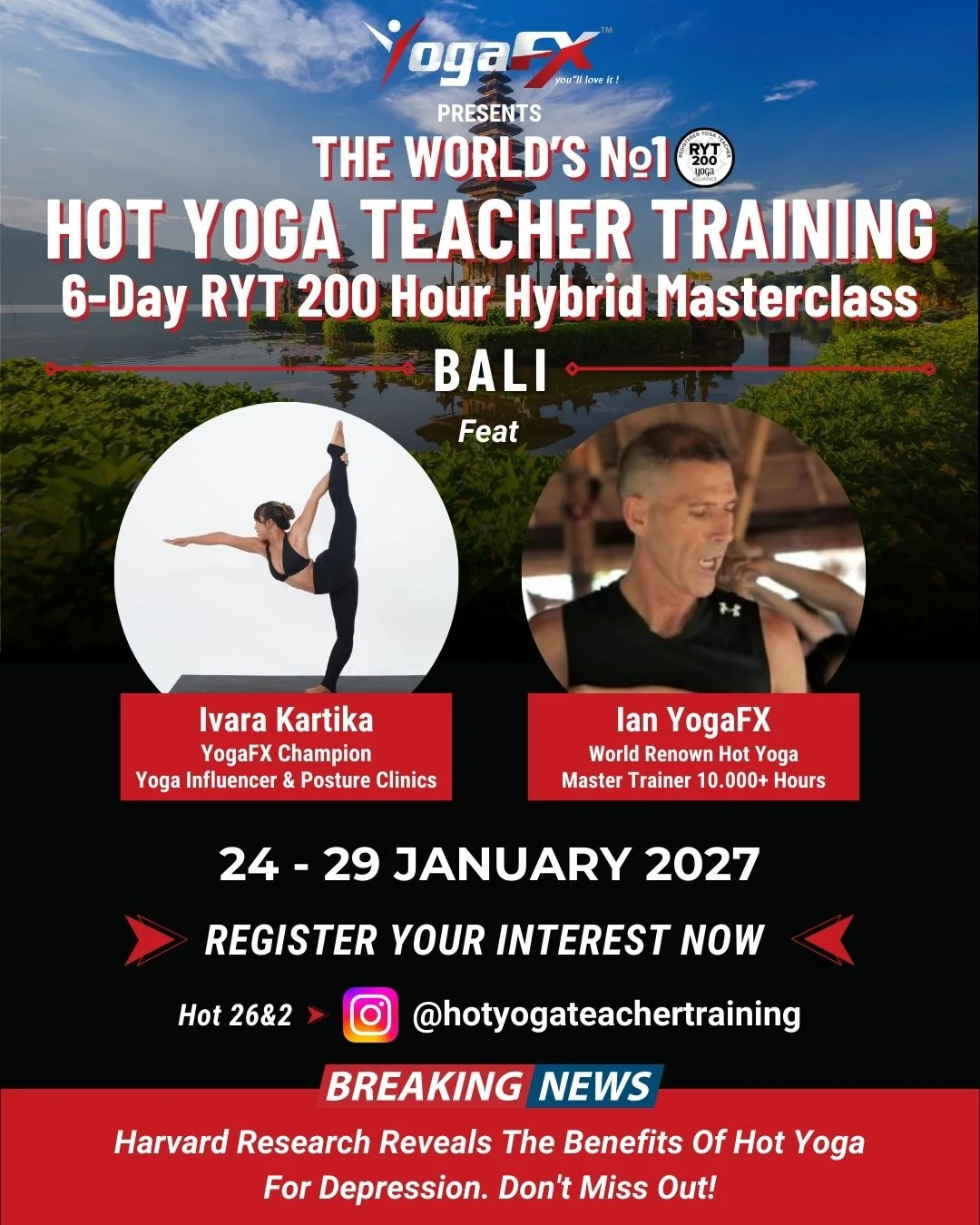
YogaFX uses a hybrid sequence: online pre-course preparation followed by a six-day intensive in Bali. Cohorts are capped at 19, tuition is USD 1,699 flat, and successful graduates receive RYT 200 plus Bikram Hot 26&2 certification. The program has operated since 2017.
Mr. Ian Terry, E-RYT 500, brings more than 12,000 teaching hours and five direct training sessions under Bikram Choudhury between 2012 and 2019. He has trained 1,500+ graduates from over 80 countries and was confirmed in June 2026 as Master Trainer of the Republic of Indonesia Yogasana Sports Federation.
The practical method remains consistent: Original Hot 26&2 Yoga, 26 postures, two breathing exercises, 90 minutes, scripted verbal dialogue, no demonstration, and no music. Studios in Seminyak and Canggu use Bali's natural tropical heat at approximately 40°C and 40% humidity, never electric heaters, and open from 06:00 to 22:00 daily.
That consistency is useful in a changing education market. Delivery tools may develop, but trainees still need to observe, speak, decide, and teach. Review the YogaFX 2027 program information and verify dates, standards, inclusions, and travel requirements directly before paying.

Frequently Asked Questions
Will hot yoga teacher training be online in 2027?
Online, in-person, and hybrid options are likely to remain available. Current Yoga Alliance standards permit distance learning and require minimum synchronous participation for registered-school credentials. Verify the current rules when enrolling and ask how the school assesses heat-specific practical skills, not only whether online delivery is allowed.
What should I verify about 2027 certification?
Check the credential name, issuing school, curriculum, assessment, delivery format, registration process, and any fees after graduation. Rules can change, so use the registering body's current official guidance rather than an old blog post. Ask employers in your intended market what they expect from a new teacher.
Are digital certificates replacing practical assessment?
A digital certificate is only a delivery and verification format. It should not replace assessment of knowledge, teaching skill, and experience. Ask how competence is demonstrated before the record is issued, how employers verify it, and whether corrections or resits are available when a trainee has not met the standard.
How early should I book a 2027 Bali training?
Start comparing programs several months before your preferred date, especially if you need flights, leave approval, insurance, or a visa. Do not pay only because a countdown creates urgency. First obtain the full timetable, trainer details, cancellation terms, health requirements, total costs, and written certification information.
Is YogaFX official Bikram Choudhury Teacher Training?
Independent training, not official Bikram Choudhury Teacher Training. YogaFX teaches Original Hot 26&2 Yoga through a hybrid pathway. Successful graduates receive the program's stated RYT 200 and Bikram Hot 26&2 certificates, subject to completion requirements that should be reviewed before enrolment.