Bikram Yoga 30 Day Challenge: Results & Before and After
By Ian Terry, E-RYT 500 · Updated

A Bikram yoga 30 day challenge can build a consistent practice, improve your familiarity with the fixed 26+2 sequence, and reveal changes that a single class cannot show. However, realistic hot yoga 30 days before and after results are broader than a scale reading or transformation photo. The most useful comparison includes attendance, heat tolerance, posture control, balance, recovery, energy, and mindset.
What Is a Bikram Yoga 30 Day Challenge?
A Bikram challenge applies a defined time frame to the traditional class: 26 postures and two breathing exercises performed in a fixed order, typically for 90 minutes in a room near 105°F (40°C). The aim is consistent exposure to the same sequence, which makes it easier to notice how technique, pacing, and attention change.
Thirty days does not need to mean 30 consecutive classes. That version may suit an experienced practitioner who already tolerates the heat and has instructor support. A beginner can still complete a meaningful challenge with three or four classes per week, recovery days, and a goal of maintaining the practice across the full month.
Before committing, study the complete Bikram hot yoga poses sequence and use the Bikram Yoga Journey Tracker to record each session.
Bikram Yoga 30 Day Challenge Results: What Is Realistic?
During the first month, the clearest result may be skill rather than appearance. You learn when the standing series becomes demanding, how much water works for you, when to rest, and how to enter and leave postures with more control. The dialogue and sequence also become familiar, reducing the mental load of anticipating what comes next.
You may notice changes in balance, perceived flexibility, muscular endurance, or confidence, but 30-day outcomes vary with baseline fitness, attendance, sleep, nutrition, health, and class intensity. A 2025 systematic review of hot yoga research found promising physical and psychological outcomes while emphasizing that the evidence pool is small and varied.
The better-known measurable gains come from longer interventions. The review reports that eight weeks of Bikram yoga performed three times per week improved lower-body strength, single-leg balance, and flexibility in controlled research. Six weeks of four sessions per week was associated with improvements in several wellbeing measures. Those findings make a 30-day challenge a useful start, not proof that everyone will reach the same endpoint within one month.
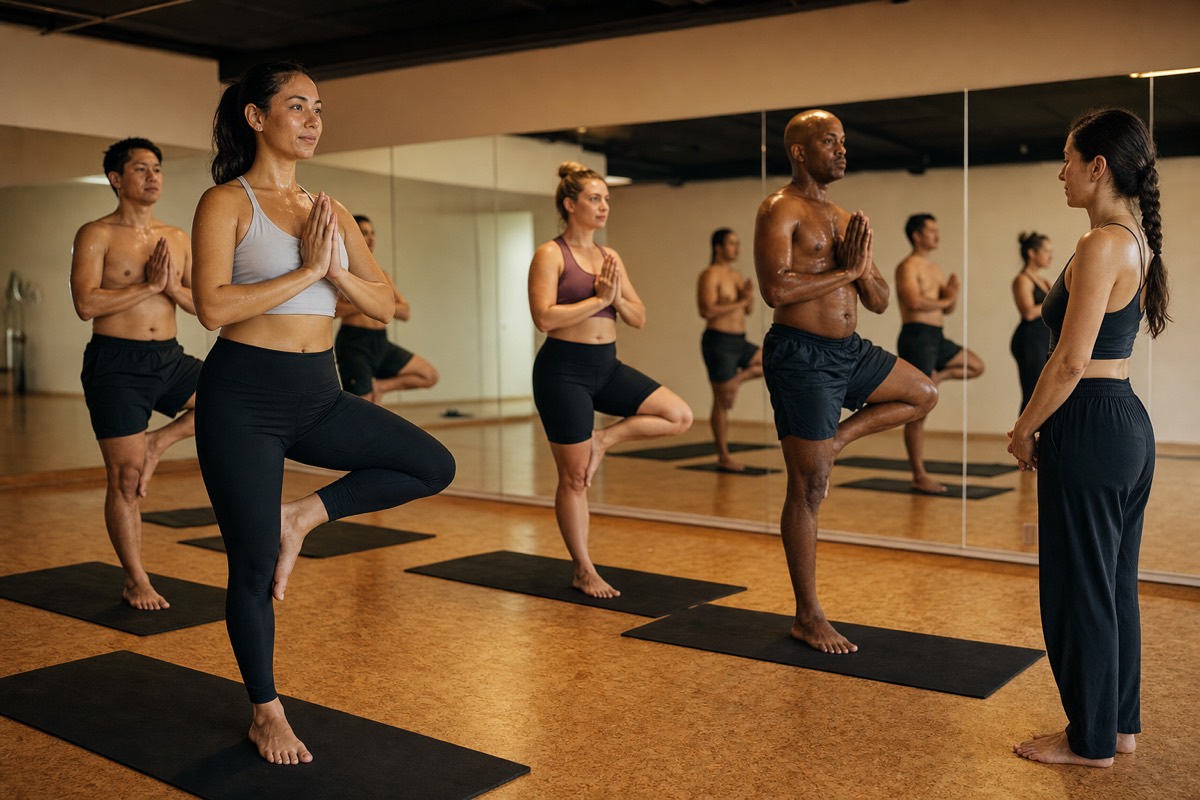
Hot Yoga 30 Days Before and After: What Should You Track?
A credible before-and-after record compares the same measures under similar conditions. Record a baseline before your first class, review it weekly, and repeat it after your final session. Do not rely on memory or judge progress only by posture depth. For a realistic timeline of what tends to change first, see how long hot yoga takes to show results.
Attendance: class date, duration, and whether you completed the standing and floor series.
Perceived effort: use the same 1–10 scale after every class.
Heat response: note dizziness, headache, nausea, unusual fatigue, and how long recovery takes.
Posture control: choose one balance pose, one strength pose, and one mobility pose instead of scoring all 26.
Recovery: record sleep, muscle soreness, energy, and readiness for the next session.
Mindset: note focus before class and calm or stress afterward using consistent language.

If you use weight or photographs, standardize the time, clothing, lighting, distance, and hydration state. A post-class body is temporarily fluid-depleted, so comparing it with a normally hydrated day-one body creates a misleading “result.”
A Sustainable 30-Day Bikram Yoga Challenge Plan
Days 1–7: Establish a baseline
Take two or three classes if you are new. Learn the room, instructor cues, rest positions, and your normal recovery time. Practise without chasing maximum depth. Experienced students can follow their usual frequency while documenting baseline measures.
Days 8–14: Build consistency
Add a class only if energy, sleep, hydration, and soreness are stable. Select one or two technique goals, such as a steady standing foot or controlled breathing. Use the Bikram Yoga Pose Personalizer for a focused recommendation, then confirm any modification with your instructor.
Days 15–21: Observe patterns
Review your notes. Identify which schedule produces good classes and which combination of poor sleep, rushed meals, or inadequate fluid precedes a difficult session. Adjust the plan instead of treating fatigue as a test of willpower.
Days 22–30: Repeat, then compare
Keep the conditions as consistent as practical. Complete your final comparison only after normal rehydration and recovery. Summarize what improved, what stayed the same, and what requires more time.
Will 30 Days of Hot Yoga Change Your Weight or Body?
Bikram classes use energy and may support a broader fitness plan. They do not guarantee visible fat loss in 30 days. Long-term body-fat change depends on total energy intake and expenditure, while body measurements also respond to hydration, digestion, hormones, and measurement technique.
The large amount of sweat produced in a heated room can lower scale weight immediately after class. That is mostly fluid loss, not instant fat loss. Research reviewed in 2025 reported average sweat losses around 1.5 litres in 90-minute Bikram sessions. Rehydration should restore much of that temporary change.
Read the evidence-focused Bikram hot yoga weight-loss guide and use the Bikram yoga calorie calculator as an estimate, not as permission to restrict food or ignore recovery.
Hydration, Recovery and Heat Safety
Repeated heat exposure adds physiological demand, even when the movement itself feels controlled. A single hot-yoga session raises heart rate, core temperature, and sweat rate. The same systematic review found that energetic demand is generally light to moderate and is not automatically higher simply because the room is hot.
Arrive normally hydrated, bring water, eat in a way that supports training, and protect sleep. Avoid both deliberate dehydration and excessive water consumption. A peer-reviewed hot yoga hydration study notes heat-specific risks including dehydration and heat illness, while published case reports show that indiscriminate overdrinking can also disturb sodium balance.

Stop exercising and move to a cooler place if you become confused, faint, severely dizzy, nauseated, unusually weak, poorly coordinated, or unable to cool down. Seek medical help for severe or persistent symptoms. Pregnancy, cardiovascular disease, uncontrolled blood pressure, previous heat illness, and medication affecting sweating, heart rate, fluid balance, or temperature regulation require individualized medical guidance.
Beginners should read the hot yoga first-class safety guide and select a facility using the Bikram yoga studio checklist.
What to Do After Day 30
Day 30 is a review point, not a finish line. Keep the measures that taught you something and discard those that encouraged unhealthy comparison. A strong result might be twelve consistent classes, better balance control, fewer rushed exits from postures, or faster normal recovery, not necessarily a dramatic photograph.
If the challenge improved your routine, choose a maintainable weekly schedule or continue with the site's 30/60/90-day Bikram Yoga Journey Tracker. If pain, persistent fatigue, heat symptoms, disrupted sleep, or anxiety increased, pause and speak with an appropriate healthcare professional before continuing.
Bottom line: the most credible hot yoga 30 days before and after result is a documented change under comparable conditions. Treat consistency, control, recovery, and self-awareness as outcomes; treat rapid weight loss and guaranteed body transformation as marketing claims, not promises.
Frequently Asked Questions
What is a Bikram yoga 30 day challenge?
It is a personal commitment to practise the fixed 26-posture and two-breathing-exercise sequence consistently for 30 days. It does not have to mean 30 consecutive classes; beginners are usually better served by a planned schedule with recovery days.
What results can I expect after 30 days of hot yoga?
You may notice better familiarity with the sequence, steadier pacing, improved confidence, and changes in perceived mobility or balance. Visible body-composition changes are not guaranteed, and stronger research on measurable fitness adaptations generally uses programs lasting six to eight weeks or longer.
Will 30 days of Bikram yoga make me lose weight?
Classes expend energy, but lasting fat loss depends on total energy balance over time. A lower scale reading immediately after class is mainly sweat-related water loss and should not be treated as fat loss.
Should a beginner do Bikram yoga every day for 30 days?
Not automatically. Start with a frequency you can recover from, tell the instructor you are new, and increase only when sleep, energy, hydration, and movement quality remain stable. Stop and seek help for signs of heat illness.
How should I take hot yoga before-and-after photos?
If you want photos, use the same lighting, clothing, distance, time of day, and hydration state. Do not use a dehydrated post-class photo as the after image. Pair photos with attendance, posture notes, balance time, sleep, and perceived effort.
What happens if I miss a day in the 30-day challenge?
Continue with the next planned session instead of doubling up to compensate. A missed day does not erase your progress. Sustainable attendance and honest tracking are more useful than preserving a perfect streak at the expense of recovery.