Bikram vs Vinyasa Yoga: Structure, Heat, and Which to Choose
By Ian Terry, E-RYT 500 · Updated
Bikram yoga and Vinyasa yoga differ in structure, temperature, and movement. Bikram yoga uses a fixed 90-minute sequence of 26 postures and two breathing exercises at about 105°F (40°C). Vinyasa yoga connects breath to changing, dynamic poses, and heat is optional. The better choice depends on whether you value repetition or creative variety.
The difference between Bikram and Vinyasa is larger than the presence of heat. One method asks the teacher and students to return to a known sequence. The other gives the teacher room to create a new journey through postures. Both can demand concentration, physical skill, and thoughtful instruction, but they train different habits.
This guide compares the two methods neutrally before addressing a more specific question: which style makes more sense to learn to a professional teaching standard? If you first need a definition of the wider category, read what hot yoga actually is.
Structure and Movement Order: Fixed Bikram Sequence vs Creative Vinyasa Flow
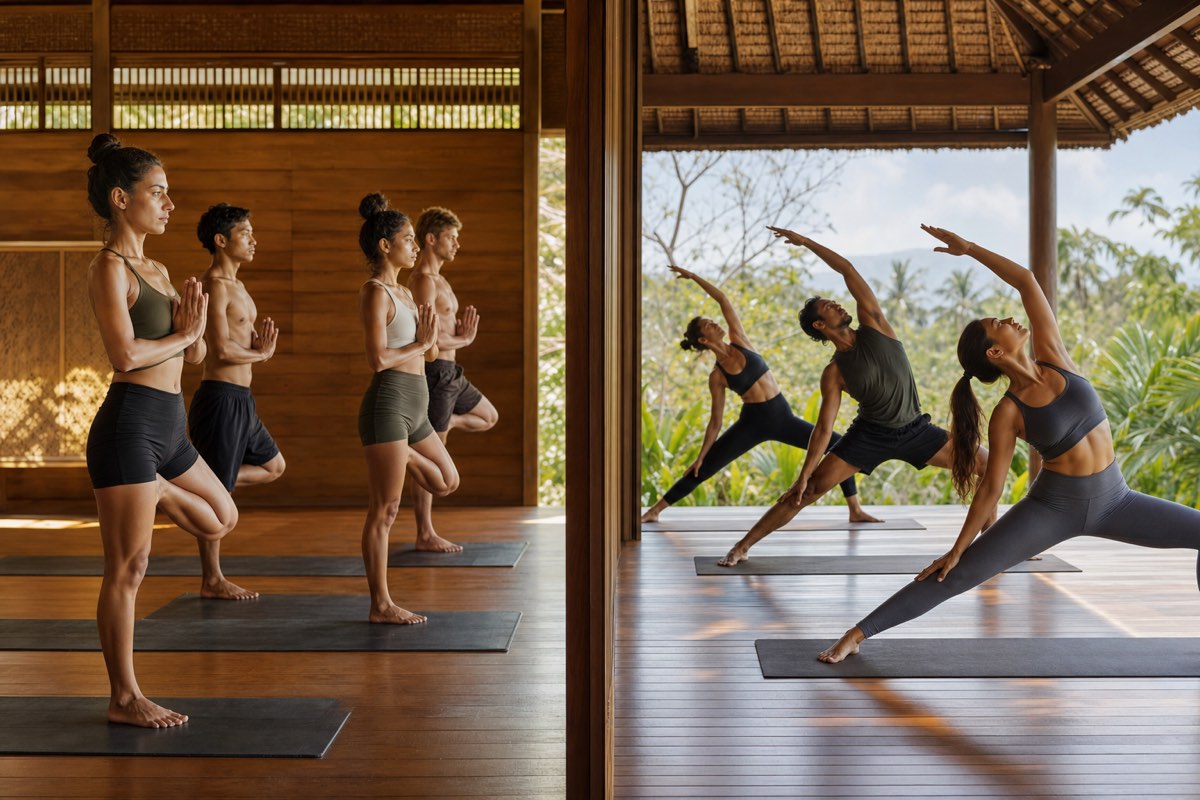
Bikram Hot 26&2 follows the same 26 postures and two breathing exercises in every complete class. The 90-minute sequence begins with breathing, moves through a standing series, continues on the floor, and finishes with a breathing exercise. Each posture occupies a known place. Students do not encounter Downward-Facing Dog, and transitions move efficiently between the fixed postures rather than forming a continuous sun-salutation pattern.
That repetition changes how a student learns. During a first class, simply staying oriented may require full attention. After several classes, the order becomes familiar. The practitioner can then notice finer details: how the standing leg behaves, whether breathing stays steady, where effort becomes tension, and how one posture affects the next. Progress is measured against the same task rather than a new sequence.
A Bikram teacher also works from a scripted verbal dialogue. The teacher does not need to invent the order while teaching, demonstrate every shape, or select music for a theme. That does not make the role automatic. The instructor must observe the room, keep timing, make the words clear, notice risk, and decide when a student needs a simpler instruction or a pause.
Vinyasa yoga is deliberately variable. Its defining idea is the connection of breath and movement, often through flowing transitions such as Chaturanga and Downward-Facing Dog. A teacher may build a class around hip mobility, backbending, balance, strength, or a peak posture. The order can change the next day, even when the class carries the same level label.
That variety can be stimulating. Students learn to respond in real time and experience a broader menu of postures and transitions. It also means the quality and difficulty of a Vinyasa class depend strongly on the instructor's sequencing, cueing, pacing, and judgment. One beginner class may move slowly through fundamentals. Another may assume familiarity with fast transitions.
Neither structure is inherently superior for practice. Repetition serves people who want a stable benchmark. Variation serves people who stay engaged through novelty and want different movement themes. The practical distinction becomes more important when the learner plans to teach, because a fixed syllabus and a creative syllabus demand different forms of preparation.
Room Temperature and Environment
A traditional Bikram class has a defined environment: approximately 105°F (40°C) with 40% humidity for 90 minutes. The warm, humid room increases thermal demand and causes heavy sweating. The atmosphere is controlled and focused. Traditional instruction uses no music, while the teacher delivers verbal dialogue and watches the class.
The fixed conditions are part of the method, not a decorative addition. A student can prepare for a known duration, sequence, and room target. That predictability also gives a teacher a common framework for hydration reminders, pacing, observation, and response to heat-related warning signs. It does not remove individual variation. Experience, health, acclimatization, sleep, and hydration still affect how someone responds.
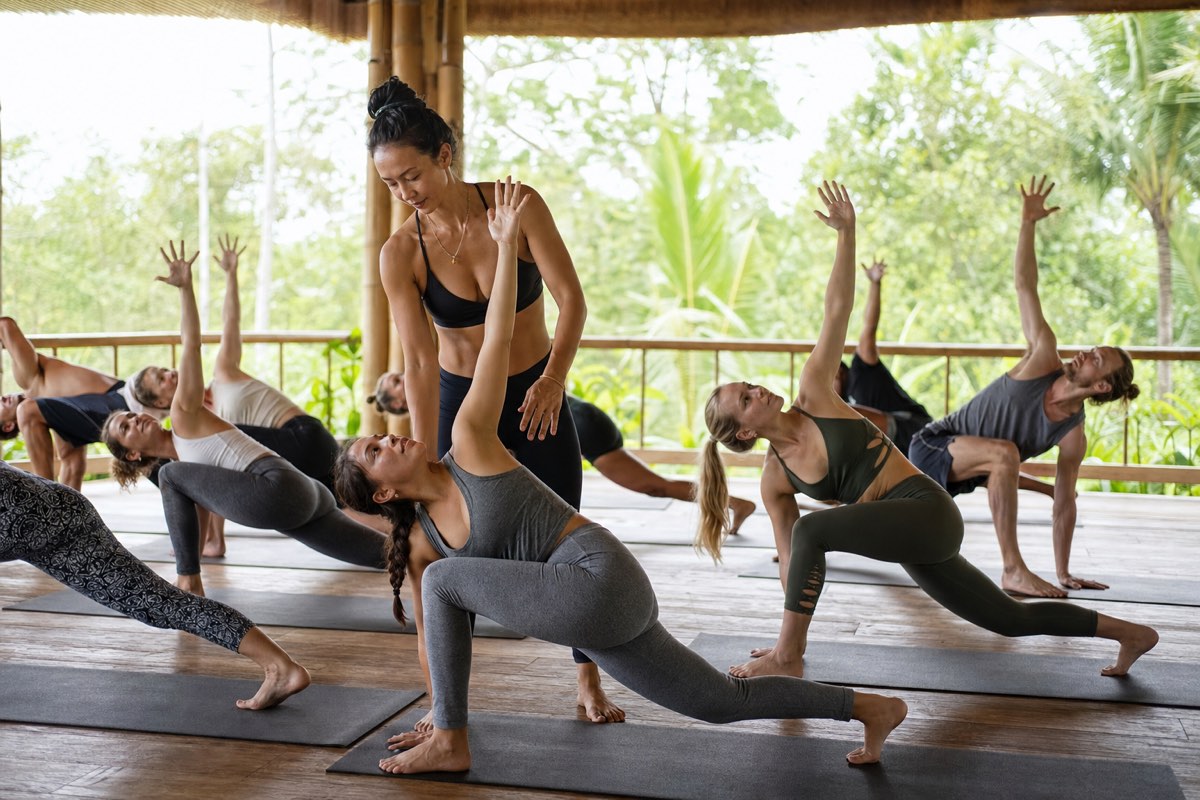
Vinyasa does not require heat. It can take place at ordinary room temperature, in an open-air pavilion, or in a heated studio marketed as Hot Vinyasa. Temperature and humidity vary by location. Music is common, though not universal, and its tempo may support a slower or more energetic class.
This is why the phrase hot yoga vs Vinyasa yoga can be misleading. Hot yoga describes an environment and broad category, while Vinyasa describes a movement approach. Hot Vinyasa combines both. A normal-temperature Vinyasa class and a heated flow class can feel very different despite sharing breath-led transitions.
Heat alone does not prove that one class is harder. A continuous Vinyasa sequence may create sustained muscular and cardiovascular work at a lower temperature. A Bikram class adds a specific heat load while alternating strong static efforts with brief transitions and rests. The better comparison considers room conditions, posture demands, pace, duration, and the student's own experience.
For either heated format, ordinary safety principles matter. Arrive normally hydrated, tell the instructor if the environment is new to you, and stop if you feel dizzy, confused, nauseous, unusually weak, or overheated. People who are pregnant or have cardiovascular concerns, heat sensitivity, or conditions affected by exercise should seek individualized medical advice before beginning.
Physical Focus and Difficulty
Bikram's standing series repeatedly challenges the legs, balance, and postural control. The floor series works through the spine and posterior chain with a predictable rhythm. Because the order stays fixed, a practitioner can compare the same Standing Bow, Triangle, Locust, or Camel from week to week without wondering whether a change came from a completely different class design.
A controlled study by Tracy and Hart in 2013 reported a 20% increase in isometric deadlift strength after eight weeks of Bikram practice. That result supports a concrete strength adaptation in the studied group. It does not promise the same percentage for every student or prove that Bikram replaces a complete resistance-training program.
A 2025 systematic review by Willmott and colleagues assessed 43 studies with 942 participants. The review found research across flexibility, strength, balance, cardiovascular measures, and psychological outcomes in heated yoga. Study methods and populations varied, so the useful conclusion is that repeated heated practice may support several adaptations, not that heat guarantees a specific result.
Vinyasa often places more repeated load through the shoulders, wrists, arms, and trunk because classes can cycle through Plank, Chaturanga, and Downward-Facing Dog. It may also explore flexibility through a wider range of postures. Yet no universal Vinyasa sequence exists, so one class can emphasize upper-body endurance while another focuses on slow mobility or balance.
Is Bikram or Vinyasa harder? For a student sensitive to heat, Bikram's room may be the decisive challenge. For someone unaccustomed to weight bearing through the hands, a fast Vinyasa class may feel harder. Bikram tests patience and precision inside repetition. Vinyasa tests adaptation to changing transitions and instructions. Personal history matters more than a universal ranking.
The long-tail question about Bikram vs Vinyasa for weight loss also needs restraint. A 2014 study led by Porcari reported average energy expenditure of about 333 calories for women and 460 for men during a 90-minute Bikram class, with heart rate near 80% of maximum. Those are averages from a study, not individual guarantees.
Vinyasa calorie expenditure changes with sequence, pace, rest, body size, and duration. Neither label predicts long-term weight change by itself. Consistent activity can contribute to energy balance, while nutrition, recovery, health, and overall weekly movement remain important. Early scale loss after a hot class is mostly sweat and water, not instant fat loss.
Why Bikram 26&2 Is Easier to Teach Consistently
The same structure that helps a student compare practice also gives a trainee a stable professional syllabus. Bikram Hot 26&2 standardizes the posture order, 90-minute timing, scripted dialogue, room target, and teaching atmosphere. A trainee knows which material must become reliable. Feedback can address the same passage, posture, timing decision, and observation skill repeatedly.
Vinyasa teachers need a different competence. They must understand how to build sequences, connect transitions, balance movement patterns, manage levels, select pacing, and often demonstrate while maintaining awareness of the room. Creativity is a strength of the style, but it also creates more variables. Consistency depends heavily on each teacher's experience and preparation.
A fixed sequence does not mean that every Bikram student receives identical treatment. Bodies, injuries, experience, and daily capacity still differ. The shared script provides the route, while the teacher applies judgment to the people present. Standardization makes the method transferable across instructors and countries, but live observation is what keeps instruction responsive.
Mr. Ian Terry, E-RYT 500, has more than 12,000 teaching hours and completed five direct training events under Bikram Choudhury between 2012 and 2019. He explains that reliable teaching begins when the dialogue, order, and timing stop competing for the trainee's attention. The trainee can then look outward, read the room, and teach the students who are actually present.
That principle is why the YogaFX certification program is built around Original Hot 26&2 Yoga rather than Vinyasa. The aim is not to declare Vinyasa inferior. It is to develop a specific, repeatable teaching skill that a graduate can carry from Bali to studios in different countries without rebuilding a class plan from zero.
Consistency also supports assessment. A trainer can hear whether required cues are clear, observe whether timing serves the class, and check whether a trainee notices common alignment and safety issues. Classmates can repeat the same material, compare feedback, and practise again. The standard stays visible throughout the process.
If You Want to Teach: Which Style Should You Choose for Certification?
Choose a certification by starting with the class you genuinely intend to teach. A person who loves creative sequencing, changing themes, music, and breath-led transitions may be well suited to Vinyasa training. A person who values repetition, precise verbal instruction, a known standard, and measurable refinement may prefer Bikram Hot 26&2.
For a career changer, Bikram's predictability can make the route to a teaching standard easier to define. There are still 26 postures, two breathing exercises, anatomy, safety, dialogue, room management, practice teaching, feedback, and assessment to learn. The advantage is not that the work is small. The advantage is that the target does not change each week.
For a serious practitioner, the decision may be about depth. Repeating the sequence as a student is different from learning why the dialogue is ordered, how timing affects the room, what a teacher watches, and how to speak while monitoring many bodies. Certification turns familiar practice into professional responsibility.
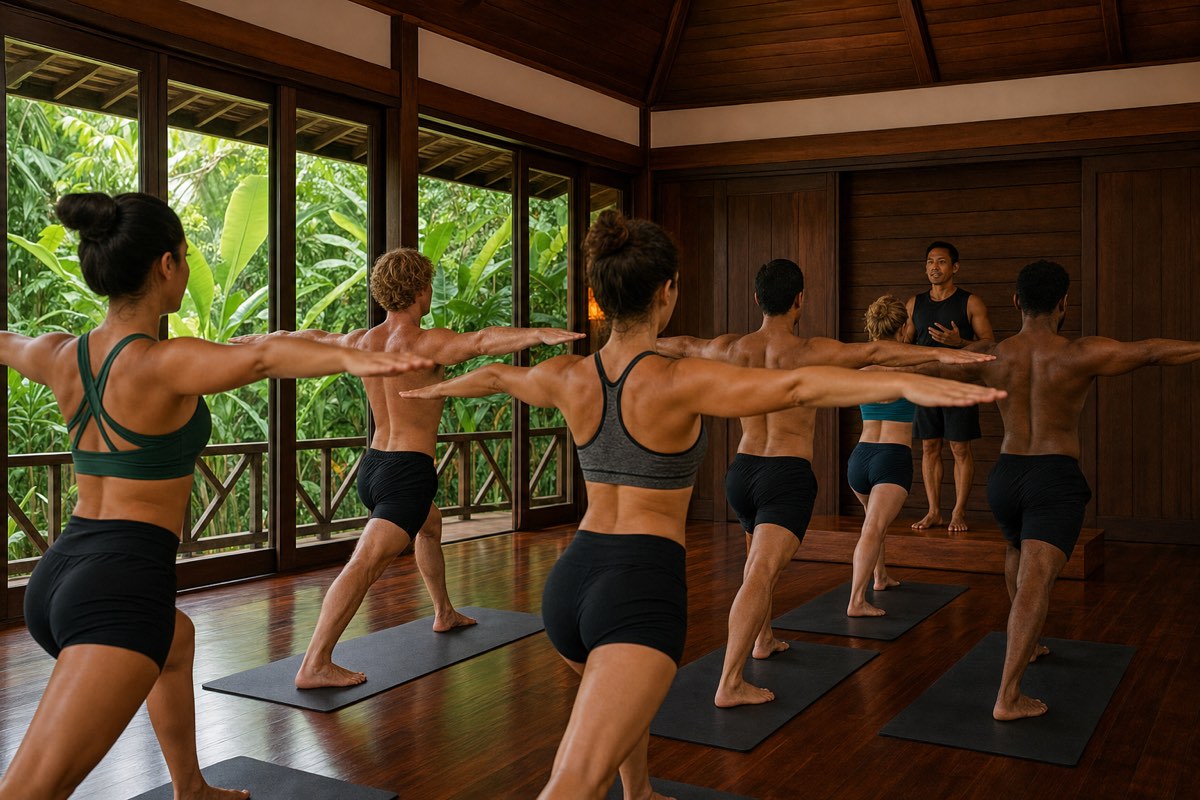
The YogaFX hybrid pathway combines an online pre-course with a six-day practical intensive in Bali. Cohorts are limited to 19 students. Graduates receive dual certification: Yoga Alliance RYT 200 plus Bikram Hot 26&2 certification. Tuition is USD 1,699, and practical training uses the Seminyak and Canggu studios in natural tropical heat.
The academy was established in 2017 and has trained 1,500+ graduates from over 80 countries. Its published social proof includes 700+ reviews across Google, Yoga Alliance, and YouTube. Mr. Ian Terry also serves as Master Trainer of the Republic of Indonesia Yogasana Sports Federation.
Before comparing headline prices, review how much a Bali teacher training actually costs. Then use the location guide to evaluate hot yoga teacher training in Bali, including studio conditions, cohort size, practical hours, travel, and what the credential covers.
If your question is which style to practise rather than which one to teach, see the practitioner-focused comparison on our sister site. That companion guide keeps the practice decision separate from the professional training decision addressed here.
When you are ready to compare certification paths, read the complete hot yoga teacher training program overview. Check the curriculum, actual trainer, supervised teaching, assessment, certification, full cost, and what support follows graduation. A polished certificate name cannot replace observed teaching practice.
You can also message Mr. Ian Terry on WhatsApp with your current practice background and the styles you are considering. Ask what the fixed-sequence training expects before Bali and what you will teach during the intensive. A direct answer should help you decide, even if you do not enrol.
The practical answer is clear: choose Vinyasa certification when creative sequencing is central to the teacher you want to become. Choose Bikram Hot 26&2 when you want a standardized method, repeated coaching, and a fixed class you can deliver consistently. The right path is the one whose daily teaching work you are prepared to practise.
Frequently Asked Questions
Is Bikram yoga better than Vinyasa for beginners?
Neither style is universally better for beginners. Bikram gives a newcomer the same sequence and timing in every class, which can make progress easier to track. Vinyasa offers more variety, but pace and complexity depend on the teacher. Try a beginner-appropriate class, explain your experience, and choose instruction that respects rest and safe limits.
Are Bikram and hot yoga the same thing?
No. Hot yoga is a broad category for yoga practised in a heated room. Bikram is a specific 90-minute method with 26 postures, two breathing exercises, approximately 40°C heat, and 40% humidity. Heated Vinyasa may use changing sequences, music, demonstrations, and different room settings, so the class label matters.
Can Bikram yoga help with weight loss compared to Vinyasa?
Both can contribute to an active routine, but neither guarantees weight loss. A 2014 Bikram study reported average expenditure of 333 calories for women and 460 for men during 90 minutes. Vinyasa energy use varies with pace and sequence. Long-term body weight also depends on nutrition, recovery, consistency, health, and total activity.
What's the difference between Bikram and Vinyasa yoga temperature?
Bikram uses a deliberately hot room at about 105°F or 40°C with 40% humidity for a fixed 90-minute class. Vinyasa can be taught at ordinary room temperature or as Hot Vinyasa, with settings chosen by the studio. Movement pace can also change perceived effort, so temperature alone does not define difficulty.
Which style is easier to get certified in?
Bikram's fixed sequence and scripted dialogue provide a standardized body of material, while Vinyasa training also requires creative sequencing. Credible training still needs anatomy, teaching practice, assessment, and feedback. Choose the method you intend to teach and verify its credential. YogaFX is independent training, not official Bikram Choudhury Teacher Training.